The Trump Administration's Economic Policies and the U.S. Economy Risks Emerging in the U.S. Economy Amid Strong Equity Market and Economic Growth
At the outset of the second Trump administration, Treasury Secretary Scott Bessent and Commerce Secretary Howard Lutnick emphasized several economic and financial challenges. This paper reviews economic and financial developments to date. As only one year has passed since the administration's inauguration, any final assessment would be premature; the following should therefore be regarded as an interim evaluation. Despite the robust equity market and economic growth at present, this paper identifies three risk factors currently emerging in the U.S. economy.
1. What Happened to Inflation Concerns from Higher Import Tariffs?
At the beginning of 2025, several U.S. think tanks and economists widely warned that large increases in import tariffs—one of the Trump administration's flagship policies—would raise import prices, push up domestic inflation, and complicate macroeconomic policy management.
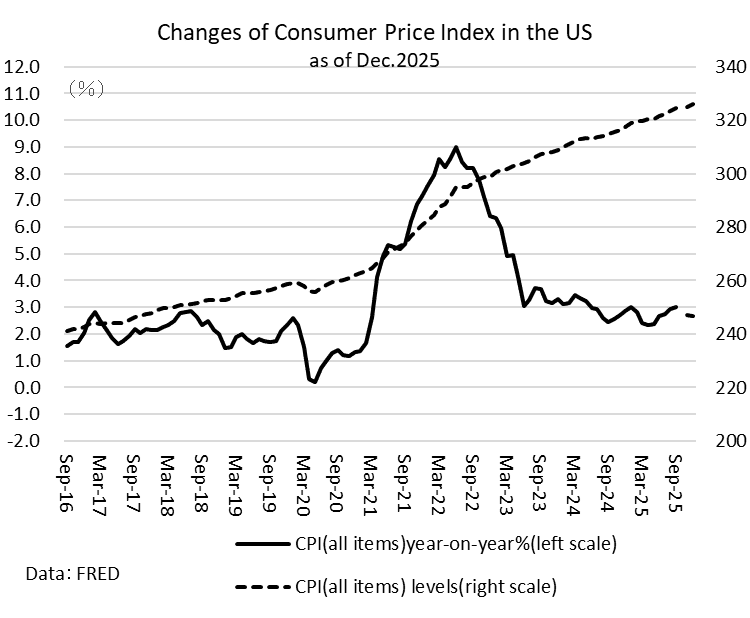
Based on the two tariff-hike scenarios discussed at the time, the author projected that headline CPI inflation would rise from the 2.0~2.9 percent range to between 4.1 and 4.5 percent year-on-year. Some institutions published even higher forecasts. In reality, however, inflation remained broadly in the 2.5~3.0 percent range, standing at 2.7 percent year-on-year in December 2025. Although it has been above the Federal Reserve's 2.0 percent target level, inflation did not exceed 3.0 percent. 1
Three factors can explain why inflation undershot the initial forecasts. First, the announced tariff hikes were partially scaled back during implementation (so-called "TACO": Trump Always Chickens Out). Second, foreign exporters reduced dollar-denominated export prices to limit sales losses. Third, U.S. importers and retailers absorbed part of the cost caused by the tariff hikes by lowering their margins, thereby limiting pass-through to consumers.
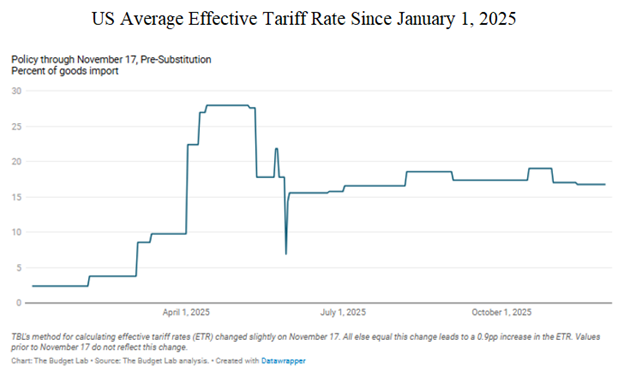
Regarding the first factor, it is necessary to examine changes in the effective U.S. import tariff rate. According to calculations by The Budget Lab at Yale University in "State of U.S. Tariffs: Jan. 17, 2026," the effective rate rose to roughly 28 percent in May 2025. Then it turned to decline, remaining at around 17 percent as of November 2025 (Figure1) 2
Figure 1
With respect to the second and third factors, estimates released by the Kiel Institute for the World Economy in Germany in January 2026 indicate that only 4.0 percent of the burden generated by higher U.S. import tariffs was absorbed through reductions in dollar-denominated prices by foreign exporters, while the remaining 96 percent was passed on to U.S. importers and consumers. 3
In addition, the National Bureau of Economic Research published a working paper analyzing tariff pass-through to retail prices (Cavallo, Llamas, and Vazquez, November 2025). It reports that prices began rising immediately after the Trump tariff measures of March 2025 and continued to increase gradually over subsequent months, with imported goods showing roughly twice the rate of increase observed for domestically produced goods. The estimated pass-through rate of tariffs to retail prices is 20 percent, and by September 2025 the cumulative contribution to the all-items consumer price index amounted to approximately 0.7 percent. 4
Applying this estimated cumulative contribution of +0.7 percent directly to the observed inflation rate of 2.7 percent year-on-year in December 2025 implies that, absent the tariff hikes, inflation rate would have been close to 2.0 percent.
It should be noted that perceptions of price increases differ somewhat between policymakers and economists on the one hand, and the general public on the other. Policymakers and economists tend to regard the problem as largely resolved once the year-on-year inflation rate declines to the 2 percent range after the surge of prices. By contrast, consumers often use past price levels as a reference point and remain dissatisfied for years with prices that stay elevated even after inflation rate subsides. This issue will be revisited later. (Figure2)
Figure 2
2. GDP Growth Boosted by the AI Investment Boom
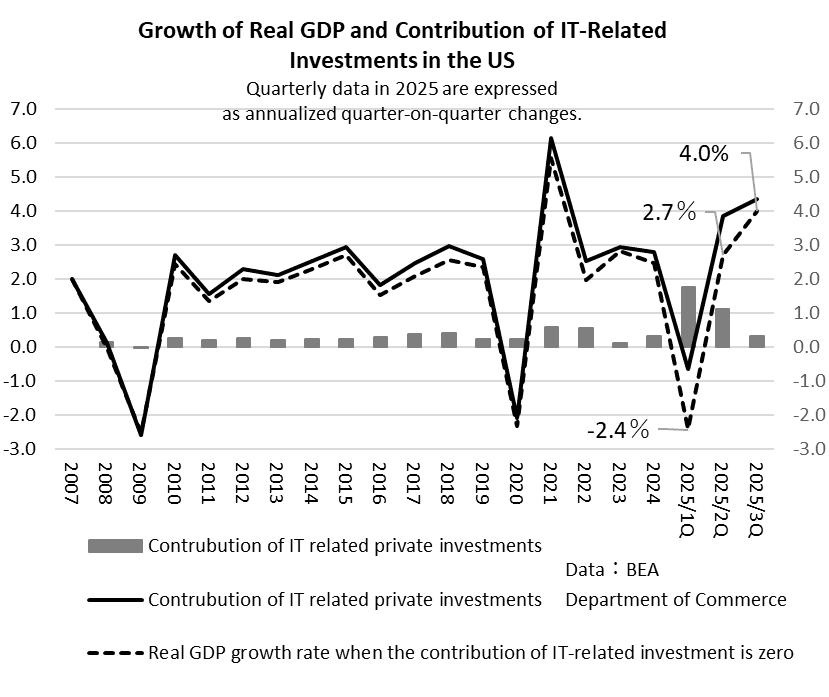
Turning next to cyclical economic trends, real GDP growth contracted by an annualized quarter-on-quarter rate of 0.65 percent in the first quarter of 2025, but the growth averaged +2.5 percent through the third quarter, indicating solid overall performance.
However, it is important to note the rising contribution of the AI investment boom. From the first quarter of 2025 onward, the contribution of IT-related private fixed investment to real GDP growth increased sharply. If the investment in this sector had merely remained flat, the averaged growth across the three quarters of 2025 would have fallen to an average of +1.4 percent. (Figure3)
Figure 3
Labor market trends reveal that, rather than generating broad-based employment gains, the AI investment boom has—at least in the short to medium term—reduced employment primarily among college-educated white-collar workers, giving rise to what can be described as a "job-loss expansion." Meanwhile, manufacturing employment, which higher import tariffs were expected to support, has remained essentially flat after the post-pandemic rebound ran its course. (Figure 4)
Figure 4
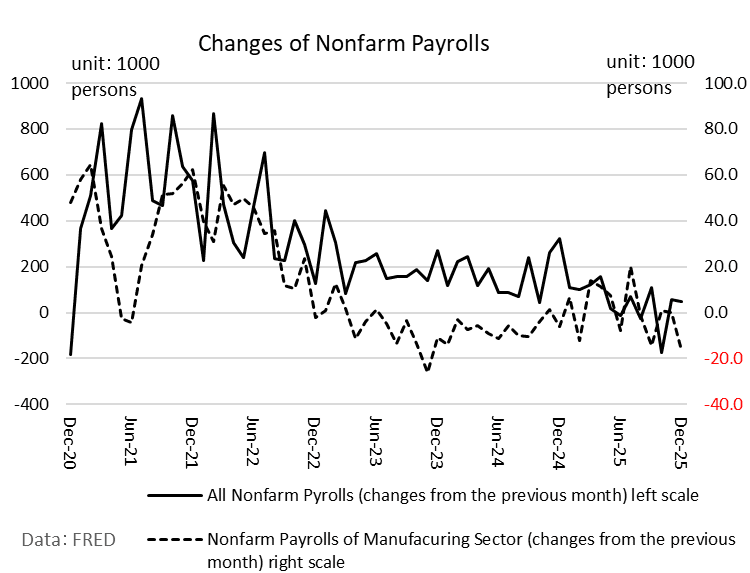
Economic momentum has thus become increasingly dependent on AI investment. While equity indices remain firm, the performance is being driven disproportionately by a limited number of AI-related stocks. As a result, concerns about an "AI bubble" have begun to surface in the equity markets. Whether a collapse akin to the early-2000s IT bubble will occur is beyond the scope of this paper. Nevertheless, given the growing dependence of both the real economy and equity markets on AI investment, a future adjustment in the AI investment boom could generate a substantial negative shock. This constitutes the first risk identified in this paper.
3. Firm Equity Market and Declining Consumer Sentiment
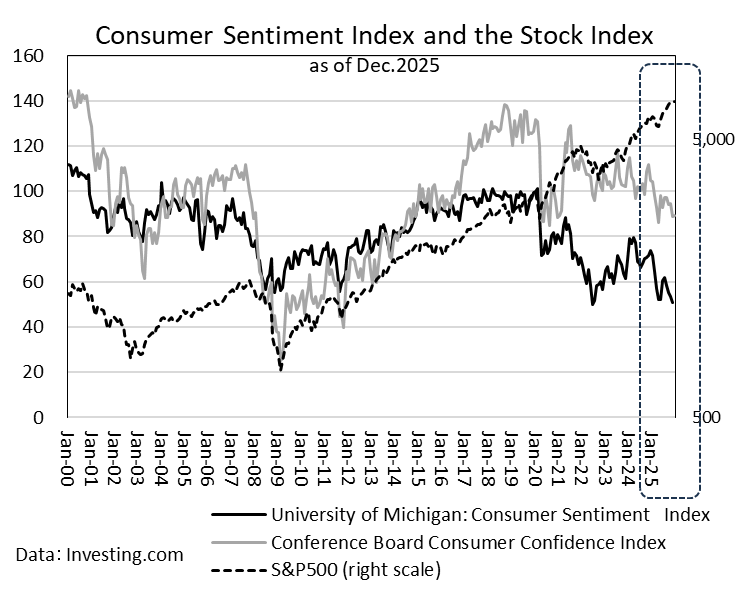
Next, it is worth noting that consumer sentiment has been declining since 2025. Figure 5 shows the trends of the University of Michigan and Conference Board consumer sentiment indexes alongside the S&P 500 stock index. In the United States, consumer sentiment indexes and stock indexes have generally fluctuated with a positive correlation.
This is, of course, due to the positive correlation between economic activity and stock price fluctuations. However, this is not the only reason. In the United States, where indirect and direct stock holdings account for a high proportion of household financial assets, from the top to middle income brackets, rising stock prices increase the market value of stock holdings, making consumers more optimistic. This, in turn, confirms a positive wealth effect, which leads to increased consumption. Given these circumstances, it is easy to see the positive correlation between stock price indexes and consumer sentiment fluctuations.
In 2025, however, this relationship reversed: the equity prices remained firm while the consumer sentiment deteriorated. Several factors may explain this decline in sentiment. First, although inflation peaked at 9 percent year-on-year in 2022 and has since slowed, price levels remain elevated. Second, housing prices surged during the same period, with the S&P CoreLogic Case-Shiller U.S. National Home Price Index reaching a year-on-year increase of 20 percent at its peak. Third, as noted earlier, AI-driven job losses have been concentrated among college-educated white-collar workers.
Figure 5
Price increases must be assessed relative to wage growth. Median real weekly wages for full-time workers in the United States, adjusted for inflation, were 2 percent lower in the third quarter of 2025 than five years earlier. As a result, even as inflation moderates to the upper 2 percent range, widespread dissatisfaction persists among consumers because wage growth has failed to keep pace with rising living costs over recent years.
This decline in consumer sentiment, particularly among middle- and lower-income households, represents the second risk identified in this paper. Such dissatisfaction is reflected in falling approval ratings for President Trump, which have declined from 47 percent immediately after inauguration to 36 percent as of December 2025, according to Gallup. The concerns are also mounting within the Republican Party ahead of the November midterm elections.
4. Trends in the Trade Balance and External Imbalances
Next, let's look at trends in the U.S. trade deficit and external imbalances, which the Trump administration has placed great importance on. As Figure 6 shows, the trade deficit (negative values are deficits) expanded sharply in the first quarter of 2025 due to last-minute imports increased sharply before the tariff hikes. Then, the deficit fell sharply in the second quarter as a reaction to this. The deficit continued to decline in the third quarter, but it will take some time to determine how much of this decline is a reaction to the first quarter and how much of this trend will become sustainable.
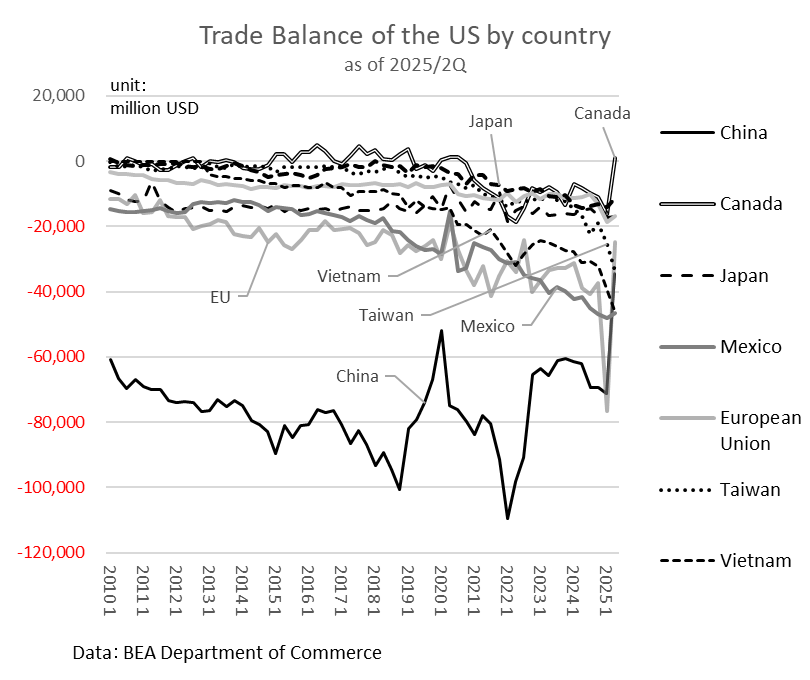
Looking at changes in the trade deficit by country (Figure 7), while the deficit with China has fallen sharply, it has widened with Taiwan, Vietnam, and Mexico. The widening deficit with Vietnam and Mexico in particular suggests that indirect exports (imports from the United States) are occurring from around the world.
If, as the administration hopes, exports from overseas companies to the United States shift to local production in the United States, then foreign direct investment in the United States should trend upward, but data up to the second quarter of 2025 shows no change in the growth rate of foreign direct investment in the United States. However, it is probably too early to assess this point at this point.
Figure 6
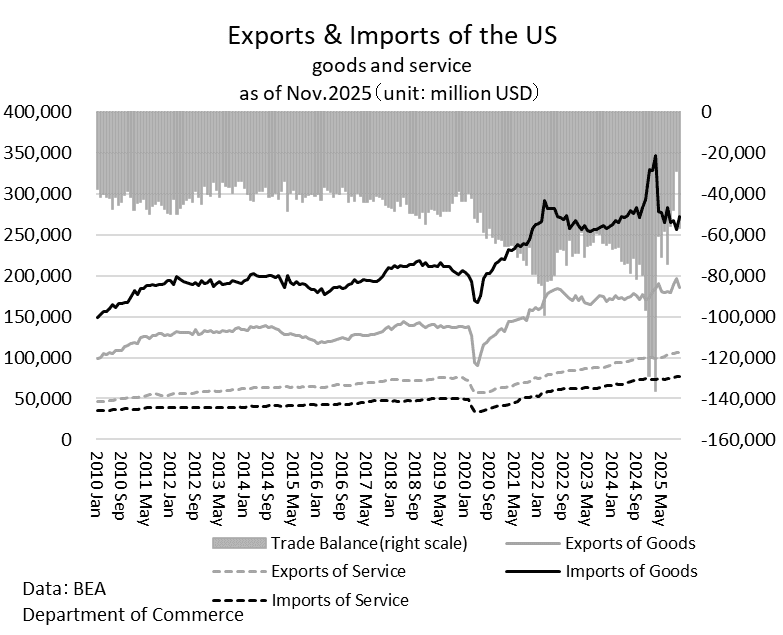
Figure 7
5. Fiscal Balance and Federal Debt
Monthly data since the inauguration of the Trump administration indicate an average federal deficit of USD 150–160 billion per month, broadly unchanged from the latter years of the Biden administration. According to the Congressional Budget Office's March 2025 projections, however, the federal deficit is expected to average 6.3 percent of GDP over the next 30 years, with federal debt rising from 107 percent of GDP in 2029 to 156 percent by 2055.5 These projections predate the enactment of the One Big Beautiful Bill (OBBB) and thus do not incorporate its effects.
While tariff revenue, which the Trump administration often boasts as an "achievement," is certainly increasing, the total amount for fiscal year 2025 (October 2024 to September 2025) will be $195 billion. This is only 3.7% of the total fiscal year revenue of $5.235 trillion.
Even if we assume that the tariff hikes lasted only six months in the last fiscal year and that they will double in the next fiscal year, given that the fiscal deficit already exceeds 6% of GDP, this will not be enough to cover additional tax cuts or the significant increase in defense spending from $900 billion to $1.5 trillion (fiscal year 2027) that President Trump announced in January 2026.
Let's take a look at the outline and expected impact of the OBBB (One Big Beautiful Bill), which was enacted in July 2025 at the initiative of the Trump administration. Based on a report by Daiwa Institute of Research (Fujiwara and Yahagi 2025)6, the following points can be summarized:
- (1) Impact on the fiscal balance: $3.4 trillion deficit increase on a basic fiscal balance basis over 10 years
- (2) Tax cuts: permanentization of Trump 1.0 tax cuts (for individuals and businesses), etc. ($4.5 trillion)
- Expenditure increases: Strengthened measures against illegal immigration ($0.3 trillion)
- Expenditure decreases: Medicaid cuts ($1.4 trillion)
- (3) Impact on the economy: The negative effects of tariff hikes and the positive effects of tax cuts will likely offset each other
6. The Expansion of the U.S. External Trade Imbalance
Finally, I would like to touch on the recent trend in the U.S. external trade imbalance. The Trump administration has expressed strong dissatisfaction with the long-standing U.S. trade deficit. It is a consensus of economists that President Trump's assertion that the U.S. trade deficit is a loss for the United States and a gain for the exporting country is complete nonsense from an economic view point.
However, as a result of the long-term trade and current account deficits, the US net external liabilities (the difference between external assets and liabilities) has been expanding as a percentage of GDP. Many economists have warned that this is "unsustainable in the long term." Nevertheless, it has continued over the long term. Moreover, in the field of international finance, this issue has been discussed in relation to the sustainability of the dollar's status as the world's key currency.
In this article, I would like to point out two changes that have occurred in recent years in the US external imbalance. First, let's look at the trend in the US current account balance (Figure 8). Within the trade balance, the services balance is in surplus, but the goods balance has been in deficit several times larger than that since the 1980s, and the current account deficit, which includes the income balance, has also been expanding, recording an annual deficit of over $1 trillion in recent years.
Figure 8
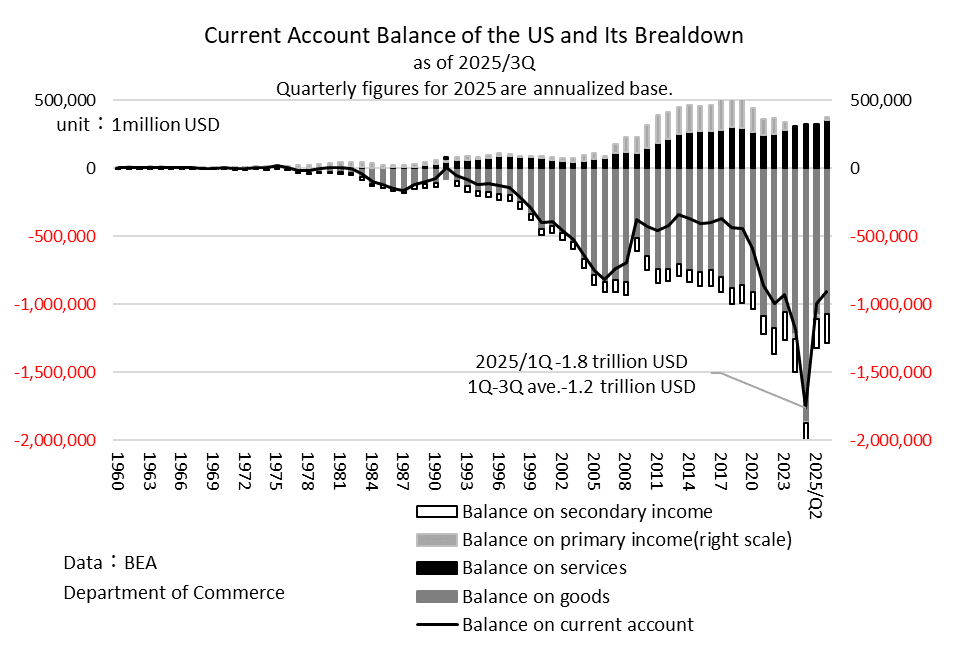
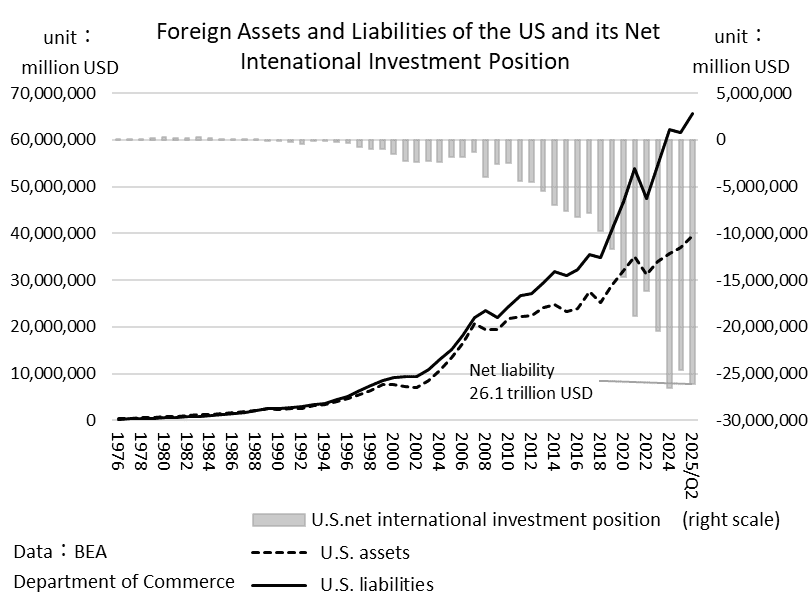
A constant current account surplus (flow), as in Japan's case, results in an increase in net external assets (stock), but a constant current account deficit results in an increase in net external liabilities. This is shown in Figure 9. Net external liabilities, which are the difference between external assets and liabilities, recently exceeded $25 trillion (approximately 90% of GDP).
Related to this the two changes are pointed out. First, the surplus in the balance of primary income (the balance between dividends & interests received from overseas and payments to overseas), which had been in surplus for a long time, has disappeared and has started to turn into a deficit since 2025 (Figure 10).
Figure 9
Even after the 1980s, when the United States became a net external liability position, the income balance remained in surplus. This was mainly the result of the higher income returns from foreign direct investments of the United Sates, while the cost of the foreign liabilities is lower than that. As a result there has been a positive return gap (1~2% per year) between the return of foreign income received and the cost of income payments to overseas.
Figure 10
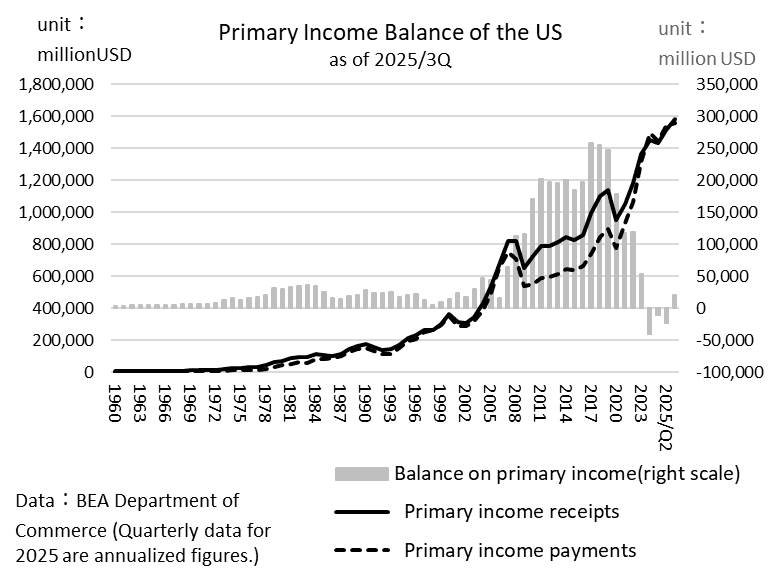
Although this positive return gap remains, the expansion of net foreign liabilities, which now accounts for 90% of GDP, has made it impossible to maintain a surplus in the income balance, and it has turned into a deficit. The Trump administration is negotiating with major countries with a stance of "producing in the United States (foreign direct investment) rather than exporting to the United States," but it should be noted that this also has the effect of resulting in an increase in the deficit in the income balance.
The second change is that the U.S.'s external assets and liabilities have shifted from macro capital gains to capital losses. Let me explain this point. First, if there are no changes in the prices of external assets and liabilities calculated in dollar terms, the past cumulative current account balance will match the changes in net external liabilities (or net assets).
However, among the United States' external assets, assets denominated in foreign currencies (stocks, bonds, loans, real estate, etc.) fluctuate with changes in their foreign currency prices and the exchange rate of the dollar. Meanwhile, the majority of U.S. external liabilities are denominated in dollars, and naturally, their market value also fluctuates. If the overall valuation gains and losses arising from price fluctuations on these external assets and liabilities are positive for the United States, they become capital gains, and the increase in net external liabilities, assessed at market value, will be smaller than the cumulative current account deficit by just this macro capital gains.
Chart 11 shows these macro capital gains and losses. Capital gains occurred from the 2000s to the 2010s ("Change in net external liabilities - accumulated deficit of the current account balance" was negative), and their size peaked at $5 trillion. This means that net external liabilities were $5 trillion smaller than the accumulated current account balance at that time.
The main factors behind this are as follows: 1) The fall in the dollar exchange rate resulted in exchange rate valuation gains on foreign currency-denominated assets held by the United States, and 2) there was a significant asymmetry between assets and liabilities of the U.S., with a high proportion of stocks (securities investments and direct investments) in U.S. external assets, while the proportion of U.S. Treasury bonds held by overseas governments and private sectors was high on the liability side. Capital gains were generated from stocks, which accounted for a high proportion on the asset side, but not from bonds, which accounted for a high proportion on the liability side, assuming they were held to maturity.
However, since 2020, capital gains have turned into capital losses (negative values on figure11), and the amount will exceed $10 trillion by the end of 2024. Why did this turn happen? It is because the above circumstances have been reversed.
Figure 11
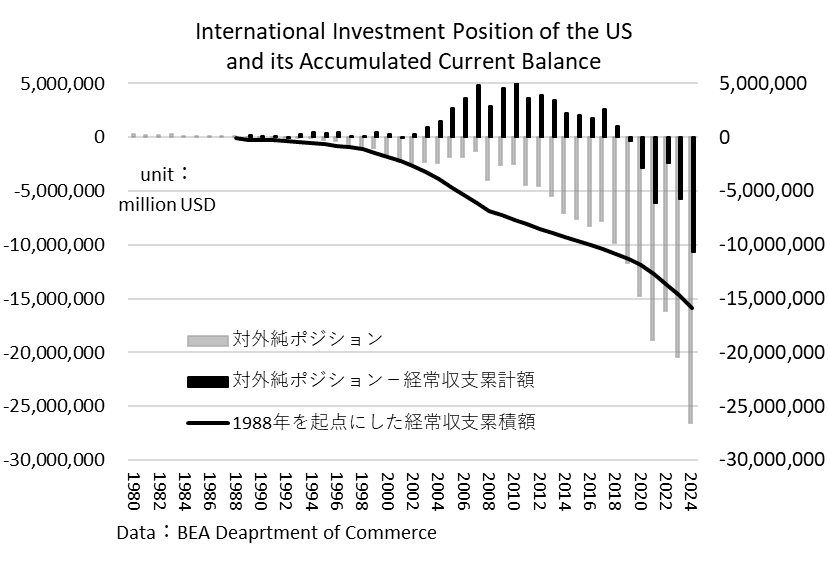
In other words, (1) the dollar has shifted from a general downward trend to a stronger trend, causing the dollar-equivalent value of U.S. assets denominated in other countries' currencies to shrink. (2) Direct investment in the U.S. from overseas, including Japan, and equity holdings in securities investments from overseas have increased, and the U.S. stock market has had the highest return in stock prices in major countries over the past decade, so overseas investors' capital gains on U.S. stocks have increased (= capital losses on the U.S. side have increased).
These changes were predicted or pointed out by the author in an article in September 2024, and since then, changes in that direction appear to have accelerated somewhat. 7
As described above, the US's external imbalance problem has seen the disappearance of its two previous advantages - an income balance surplus and huge capital gains on its external position - and the resulting disadvantage of an income balance deficit and macro-level capital losses. While this problem will not immediately lead to a kind of crisis, it appears increasingly likely that in the medium to long term the US economy will enter a period of major adjustment, including a possible decline in the dollar. This is the third risk to the US economy that this paper points out.
(Masaharu Takenaka, Professor Emeritus, Ryukoku University)
- May, 2026, "Religious Resurgence and Trump 2.0: Kirk's Legacy, University Control, and Immigration Management" by Yoshiyuki Kato, Professor, Rikkyo University
- May, 2026, "The Founding of America and Conspiracy Theories" by Tsuyoshi Kamimura, Associate Professor, Kwansei Gakuin University
- May, 2026, "Latin American Diplomacy under Trump 2.0: The Scope and Effectiveness of the "Western Hemisphere" Policy" by Suguru Osawa, Associate Professor, Aichi Gakuin University
- April, 2026, "Is Trump 2.0's Foreign and Security Policy Strategic?" by Tsuneo Watanabe, Senior Fellow, The Sasakawa Peace Foundation
- April, 2026, "The Trump Tariffs and Its Ramifications" by Yorizumi Watanabe, Professor Emeritus, Keio University
- April, 2026, "Donald Trump's Vision of the State and the Separation of Powers: An Analysis of His Tariff Policy" by Takeshi Umekawa, Professor, The University of Tokyo
- March, 2026, " Has U.S.–China Competition Eased under Trump 2.0? " by Ryo Sahashi, Professor, The University of Tokyo
- March, 2026, "Economic Security Under Trump 2.0 : A Shift in Values and Changing Options " by Kousuke Saitou, Professor, Sophia University
- March, 2026, " The Trump Administration's Economic Policies and the U.S. Economy: Risks Emerging in the U.S. Economy Amid Strong Equity Market and Economic Growth " by Masaharu Takenaka, Professor, Ryukoku University
- February, 2026, "The Impact of Russia-North Korea Military Cooperation on Regional Security" by Narushige Michishita, Vice President, National Graduate Institute for Policy Studies
- February, 2026, "The Sino-Russian Strategic Partnership and Japan's Security: Future Trajectories and Implications" by Shinji Yamaguchi, Senior Fellow, National Institute for Defense Studies
- February, 2026, "A Perspective on Russia's National Security Strategy: Focusing on the ‘Multipolar World,' ‘Anti-Westernism,' and ‘Nuclear Status'" by Shinji Hyodo, Vice President for Academic Affairs, National Institute for Defense Studies
- February, 2026, "The Possible Revival of "Imperial Russia" and What It Means for Asia and Japan" by Akio Kawato , Former DCM, Embassy of Japan in Russia
- February, 2026, "Russia After the Ukraine War: A Challenge to Japanese Security Strategy" by Matake Kamiya, Professor, The National Defense Academy
- January, 2026, "The Future of US-Russia Relations under Trump 2.0: Implications for Japan" by Taisuke ABIRU, Senior Research Fellow, the Sasakawa Peace Foundation
- January, 2026, "Hybrid Warfare Transformed Amidst the Ukraine War: Russian Tactics and the Global Diffusion of Threat" by Yoko HIROSE, Professor, Keio University
- October, 2025, "The End of Pax Americana and the Rise of China" by Nobuhiko Tamaki, Ph.D. Professor, Chuo University
- October, 2025, "China's "Kill ‘Three' Birds with One Stone" Approach to Deep-Seabed Resource Development" by Chisako Masuo, Professor, Kyushu University
- October, 2025, "Geopolitics of Science and Technology: China's Scientific Revolution vs. Trump 2.0" by Haruo Kurasawa, Science Journalist
- October, 2025, "China's Strategic Gains and Losses from the Ukraine and Middle Eastern Conflicts and Its Military Partnership with Russia" by Masafumi Iida, Director, Security Studies Department, The National Institute for Defense Studies
- October, 2025, "Medium- to Long-Term Prospects of the Chinese Economy" by Toshiya Tsugami, Director, Tsugami Toshiya's Works
- October, 2025, "China's Military Power as It Celebrates Its Centennial " by Bonji Ohara, Founder & Rep. Director, DEEP DIVE
- October, 2025, ""Pax China" from the Global South's Perspective" by Shin Kawashima, Professor, The University of Tokyo
- July, 2025, "What Makes Modi 3.0 Distinct and a Future Outlook" by Toru Ito, Professor, The National Defense Academy
- July, 2025, "Mid- to Long-Term Outlook for the Indian Economy: How to Assess the Indian Market―Benefits and Challenges of Japan-India Collaboration" by Go Yamada, Principal Economist, Japan Center for Economic Research
- July, 2025, "The India-China Border Issue and India's Military Strategy" by Satoru Nagao, Research Fellow, Hudson Institute
- July, 2025, "Where the India-Pakistan Conflict Is Headed" by Satoru Nagao, Research Fellow, Hudson Institute
- July, 2025, "India, a Leader in the Global South - What Is It Really Like?" by Tomoko Kiyota, Associate Professor, Nagasaki University
- July, 2025, "India's Diplomacy with the United States and Russia" by Mari Izuyama, Chief Research Fellow, National Institute for Defense Studies
- July, 2025, "Japan-India Security Cooperation in India's Grand Strategy" by Kazutoshi Tamari,Professor, Chukyo University
- July, 2025, "What's Next for Japan-India Strategic Partnership" by Kenji Hiramatsu, Former Ambassador to India
- April, 2025, "Outlook for the US Economy: Whether the "Golden Age" Is Beginning?" by Akihiko Yasui Director, Mizuho Research & Technologies, Ltd.
- April, 2025, "China's Economy Facing Internal and External Challenges" by Osamu Tanaka,Visiting Professor, Takushoku University
- April, 2025, "The Role of the Private Sector in Economic Security: Reflections from Japan-US and Public-Private Relations Perspectives" by Kohei Takeda Research Associate, Weatherhead Center for International Affairs at Harvard University
- April, 2025, "Proposal for Strengthening the Competitiveness of Japan's Defense Industry: Shift from the "Family Type" to the "Strategic Keiretsu-Type" System" by Yuzo Murayama Professor Emeritus, Doshisha University
- April, 2025, "Considering Economic Security Focusing on Food and Energy Security" by Takashi Sekiyama Professor, Kyoto University
- March, 2025, "An Outlook for the Japanese Economy" by Takao Komine, Visiting Professor, Taisho University.
- March, 2025, "Considering Social Security and Tax Reforms: What Will Become of Japan's Fiscal Reconstruction?" by Kazumasa Oguro, Professor, Hosei University.
- March, 2025, "Progress in Economic Security Policies and Further Strengthening of National Security Policy Integration Amid the Acceleration of "Securitization"" by Nobushige Takamizawa, Visiting Professor, The University of Tokyo.
- March, 2025, "From Economic Security to Geoeconomics" by Kazuto Suzuki, Professor, The University of Tokyo.
- January, 2025, "Healthcare Policy in the Second Trump Administration" by Takakazu Yamagishi Professor, Nanzan University.
- January, 2025, "Foreign and Security Policies of the Second Trump Administration" by Yuki Tatsumi Senior Fellow at the Stimson Center.
- January, 2025, "The Second Trump Administration and Japan-US Relations: Viewed by a Former Practitioner of Diplomacy" by Koji Tomita Former Ambassador to the United States.
- January, 2025, "The "FEAR" Returned: The Meaning of Trump's Reinstatement" by Koji Murata Professor, Doshisha University.
- December, 2024, "Analysis of the Trump Vote in the 2024 U.S. Presidential Election" by Takeshi Iida Professor, Doshisha University.
- December, 2024, "Trump's Victory Factors: Why Trump Wanted to Be President Again" byTsuneo Watanabe Senior Fellow, the Sasakawa Peace Foundation.
- December, 2024, "Kamala Harris and Factors Behind Her Defeat:Can the Democrats Make a Comeback?" by Masahito Watanabe Professor, Keio University.
- December, 2024, "American Democracy and Society Viewed from an Analysis of the 2024 US Presidential Election" by Takayuki Nishiyama Professor, Seikei University.
- October, 2024, "Assessment of Russia's Military Strength, Stockpiles, and Defense Production Base: Evaluating Russia's Capability to Continue Warfare" by Yu Koizumi, Associate Professor for RCAST, The University of Tokyo.
- October, 2024, "Germany's Arms Assistance for Ukraine: Has Its Culture of Self-Restraint Been Overcome?" by Norihide Miyoshi who served for The Japan News).
- October, 2024, "Russia's War Costs: Military Expenditures and Resource Allocation in "Wartime"" by Miho Okada, Professor, National Defense Academy.
- October, 2024, "Assessment of Russia's Military Strength, Stockpiles, and Defense Production Base: Evaluating Russia's Capability to Continue Warfare" by Yu Koizumi, Associate Professor for RCAST, The University of Tokyo.
- October, 2024, "Economic Sanctions and the Russian Economy" by Makoto Onozuka,Research Manager, Japan External Trade Organization.
- October, 2024, "Russia's Prolonged Military Invasion of Ukraine and Ukrainian Public Opinion: Focusing on Perceptions of Negotiations, Territory, and Sovereignty" by Tsuyoshi Goroku Associate Professor, Nishogakusha University.
- September, 2024, " The Russia-Ukraine War Viewed from War Termination Theory" by Yasuaki Chijiwa Chief Research Fellow, National Institute for Defense Studies.
- September, 2024, " How the Winter War Ended: A "Compromised Peace" Ends the Ukraine War?" by Tomoyuki Hanada Chief Research Fellow, National Institute for Defense Studies.
- September, 2024, " The End of the Soviet-Afghan War" by Takeshi Yuasa Professor, Sophia University Professor, Sophia University.
- July, 2024, " The Yoon Suk-yeol Administration and the ROK-Japan Relations" by CHOI, EunmiJ, The Asan Institute for Policy Studies, Research Fellow.
- July, 2024, " The 22nd National Assembly Election and South Korean Politics " by Hideki Okuzono, Professor, University of Shizuoka.
- July, 2024, " South Korea's Economic Security Policy and New Japan-ROK Economic Cooperation" by Satoru Okuda, Professor, Asia University.
- July, 2024, " Japan-ROK Cooperation: Not an Option but a Must" by Chey Tae-won, Chairman and CEO SK Inc.
- July, 2024, "Examining the Yoon Administration's Foreign Policy over the Past Two Years " by Junya Nishino, Professor, Keio University
- July, 2024, "North and South Korea Enter a New Phase of Competition" by Narushige Michishita, Executive Vice President and Professor at the GRIPS.
- July, 2024, "The Camp David Summit and U.S.-Japan-ROK Security Cooperation" by Yasuyo Sakata.
- April, 2024, "The Middle East Question and Japan" by Sinan Levent, Professor, Ankara University
- April, 2024, "The Israel-Hamas War and the Disruption of the Rules-Based International Order-Viewed from Theories of International Politics-" by Matake Kamiya, Professor, National Defense Academy of Japan
- March, 2024, " Regional Political Dynamics in the Middle East - Factors Changed and Remained unchanged after the October 7th Incident-" by Amane Kobayashi, Senior Researcher, the Institute of Energy Economics, Japan
- March, 2024, "The Ukraine War and Russia's Changing Middle East Diplomacy " by Taisuke Abiru, ,Senior Research Fellow, the Sasakawa Peace Foundation
- March, 2024, "Superpowers' Engagement with the Middle East and Their Intentions " (Edited lecture transcript) by Koichiro Tanaka, Professor, Keio University
- March, 2024, " Why the Israel-Hamas War Broke Out?" by Hiroyuki Suzuki, Professor, Associate Professor, The University of Tokyo
- March, 2024, " The Middle East Peace Process-Its Development and Future " by Chie Ezaki, Associate Professor, National Defense Academy of Japan
- March, 2024, "The Origin and Prospects of the Question of Palestine -Transformation of Israeli Politics and "10/7" as a Boiling Point- " by Aiko Nishikida, Professor, Keio University
- January, 2024, "Indonesia's Global South Diplomacy and Its Impact on Domestic Politics" by Jun Honna, Professor, Ritsumeikan University
- January, 2024, "Brazilian Foreign Policy and the Global South" by Hiroyuki Urabe, Professor, Dokkyo University
- January, 2024, "Africa's Population Explosion:How the "Last Frontier" Will Change the World" by Keiichi Shirato, Professor, Ritsumeikan University
- January, 2024, "The Impact of PM Modi's Global South Policy on the Military Strategy of India" by Satoru Nagao, Research Fellow, Hudson Institute
- December, 2023, "The Global South Concept and Its Historical Development and Outlook" by Ken Jimbo, Professor, Keio University
- December, 2023, "India's Global South Diplomacy and Japan" by Toru Ito, Professor, National Defense Academy
- December, 2023, "The Global South Viewed from China's Perspective" by Shin Kawashima, Professor, the University of Tokyo
- October, 2023, " Political and Social Divide in the United States and Challenges for Democracy" by Kazuhiro Maeshima, Professor, Sophia University
- October, 2023, " Has US Foreign Policy Doctrine Changed? " by Tsuneo Watanabe, senior Fellow, Sasakawa Peace Foundation
- October, 2023, " America's Journey to Hegemony and Its Challenges" by Koji Murata, Professor, Doshisha University
- September, 2023, " A Medium- to Long-Term Outlook for the US Economy―Can America Win the Competition with China?―" by Tatsuhiko Yoshizaki, Chief Economist, Sojitz Research Institute, Ltd.
- September, 2023, " China's Strategy toward the U.S " by Toshiya Tsugami, Adjunct Researcher, the Japan Institute of International Affairs
- September, 2023, " The Deepening Security Dilemma in US-China Relations " by Ryo Sahashi, Associate Professor, the University of Tokyo
- July, 2023, "How Would North Korea and China Use Nuclear Weapons? -- Scenarios for Discussion" by Narushige Michishita, Professor at the National Graduate Institute for Policy Studies
- July, 2023, "Japan's Nuclear Strategy" by Nobukatsu Kanehara, Visiting Professor at Doshisha University
- July, 2023, "G7 Hiroshima Summit and Efforts for a Safer World Without Nuclear Weapons" by Nobushige Takamizawa, Visiting Professor at the University of Tokyo
- July, 2023, "Roundtable Discussion—Let's Talk Frankly About Nuclear Issues" by SSDP Discussion Members
- June, 2023, "Exploring the Possibility of Nuclear Attacks on Japan-Nuclear Simulations in the Era of "Three-Front Nuclear Threats" by Hiroyasu Akutsu, Professor, Heisei International University
- June, 2023, "China's Aim to Become a Nuclear Superpower" by Masafumi Iida, Head of China Division at the National Institute for Defense Studies
- June, 2023, "Challenges for Nuclear Arms Control in the Era of Strategic Competition Among Major Powers" by Nobumasa Akiyama, Professor, Hitotsubashi University
- June, 2023, "Mechanisms and Functions of Nuclear Deterrence-Development of US Nuclear Strategic Theory" by Masashi Murano, Research Fellow of Hudson Institute
- April 2023, "Changing NATO's "Achilles Heel"—Security in the Baltic Region" by Sanshiro Hosaka, Fellow,The International Centre for Defence and Security, Estonia
- April 2023, Evolution of European Security System - Visualization of Deterrence by NATO and the "Russian Problem" by Michito Tsuruoka, Associate Professor, Keio University
- April 2023, "An Expanded NATO's Nuclear Strategy" by Yoko Iwama
- March, 2023, "Germany's Civilian Power Model—Modification or Termination?--Germany Struggling with the War in Ukraine" by Toshiya Nakamura, Professor, Nagoya University
- March, 2023, "France and the Ukraine War―The Logic Behind Macron's Security Policy" by Ken Endo, Professor, The University of Tokyo
- March, 2023, "The Russo-Ukrainian War and the British Response: 2014-2023" by Yuichi Hosoya, Professor, Keio University
- March, 2023, "Where is America Heading—Implications and Challenges for the Allies" by Koji Murata, Professor, Doshisha University
-
December 2022, Proposal "Defending Our Country – Defense Policy in a New Cold War Era" was announced
- Front Cover
- Changes in the Security Environment Surrounding Japan - Shifting Power Balance and the Three Front Threats Ken Jimbo
- How Will "Japan Contingencies" Emerge? Osamu Onoda
- The Japan-US Alliance Revisited: Is it Dependable? Chikako Kawakatsu Ueki
- A New Phase of Defense Diplomacy and Defense Production and Technology Base Ippeita Nishida, Tsuneo Watanabe
- Intelligence Activities in the Post-Ukraine War Era Jun Nagashima
- Responding to the Nuclear Threat Masashi Murano
- No Time to Lose for Improving Japan's Defense Capabilities - Can the JSDF Defend the Homeland? - Ryoichi Oriki
- Toward the Formulation of a New "National Security Strategy" Hideshi Tokuchi
- October 2022, "Japan-China Relations under the Long-term Administration of Xi Jinping: Current Status, Prospects, and Expectations" written by Kazuyuki Suwa, Professor, University of Shizuoka
- October 2022, "China's Policy on the Global South --- China's World View and the Configuration of the US-China Confrontation " written by Shin Kawashima, Professor, the University of Tokyo
- October 2022, "Military Strategy of Xi Jinping's China" written by Bonji Ohara, Senior Fellow, Sasagawa Peace Foundation
- September 2022, " Social Governance by the Communist Party of China: The Present State and the Future Prospects " written by Kazuko Kojima, Professor, Keio University
- September 2022, "The Relationship between Domestic Politics and Diplomacy under the Xi Jinping Administration- Why Were the Large-Scale Military Exercises Decided?" written by Chisako T. Masuo, Professor, Kyushu University
- September 2022, "Xi Jinping's China--- Prospects for Its Climate Change Policy ---" written by Takashi Sekiyama, Associate Professor, The University of Kyoto
- August 2022, " Current Assessment of the Xi Jinping's Rule and Prospects for the Third Term of the Xi Administration " written by Takashi Suzuki, Associate Professor, Aichi Prefectural University
- August 2022, " Economic Challenges Awaiting the Xi Jinping Administration As it Enters its Third Term" written by Toshiya Tsugami, Director, Tsugami Toshiya's Works
- July 2022, "The Russian Invasion of Ukraine and the Future International Legal Order" written by Masahiro Kurosaki, Associate Professor, National Defense Academy
- July 2022, "The Ukraine War and Security in East Asia" written by Narushige Michishita, Vice President, National Graduate Institute for Policy Studies
- July 2022, "How Will the Ukraine War Change the New US-China Cold War?" written by Yasuhiro Matsuda, Professor, the University of Tokyo
- July 2022, "Impact of the Ukraine War on the Global Economy" written by Tatsuhiko Yoshizaki, Chief Economist, Sojitz Research Institute, Ltd.
- June 2022, "Why War Occurs in Europe?--The Structural Transformation of the European Security Order in the Post-Cold War Era --" written by Yuichi Hosoya, Professor, Keio University
- June 2022,"The Russia-Ukrainian War and the Behind-the-Scenes Stance of the United States" "On Economic Security" written by Tsuneo Watanabe, Senior Fellow, Sasakawa Peace Foundation
- June 2022, "The Russia-Ukraine War and NATO", written by Michito Tsuruoka, Associate Professor, Keio University
- June 2022, "The Ukrainian War Viewed from Theories of International Politics" written by Matake Kamiya, Professor, National Defens Academy
- March 2022, "Economic Security Challenges and Cyber Security" written by Jun Osawa, Senior Research Fellow, Nakasone Peace Institute
- March 2022, "On Economic Security" written by Matake Kamiya, Professor, the Ntional Defense Academy
- March 2022, ""Economic Security" and the Review of the 2013 NSS and the Related Strategy Documents" written by Nobushige Takamizawa, Visiting Professor, the University of Tokyo
- March 2022, "The US-China Rivalry and Economic Security" written by Yuzo Murayama, Professor, Doshisya University
- March 2022, "Japan's National Security Policies and Science and Technology" written by Nobukatsu Kanehara, Professor, Doshisya University
- March 2022, "Economic Security in the Free Trade Regime" written by Kazuto Suzuki, Professor, the University of Tokyo
- January 2022, "The 2022 South Korean Presidential Election and the Next Administration's Foreign and Security Policy" written by Junya Nishino, Professor, Keio University
- January 2022, "North Korea's Nuclear and Missile Development and Japan's Defense" written by Hideshi Tokuchi, Senior Fellow, GRIPS
- January 2022, "What will Become of Japan-South Korea Relations? The 1965 Japan-South Korea Treaty System in Jeopardy" written by Masao Okonogi, Professor Emeritus, Keio University
- December 2021, "Economic and Social Conditions in North Korea and its Relations with South Korea" written by Mitsuhiro Mimura, Chief Research Fellow, The Economic Research Institute for Northeast Asia.
- December 2021, "China's Korean Peninsula Policy and North Korea" written by Shin Kawashima, Professor, the University of Tokyo.
- December 2021, "China's Korean Peninsula Policy and North Korea" written by Shunji Hiraiwa, Professor, Nanzan University.
- December 2021, "What to Do with the Relations with North Korea?" written by Hitoshi Tanaka, Chairman for Institute for International Strategy at the Japan Research Institute.
- October 2021, "Strategic Implications of North Korea's Enhanced Nuclear and Missile Capabilities" written by Narushige Michishita, Vice President, National Graduate Institute for Policy Studies.
- October 2021, "The Biden Administration's North Korea Policy: Its Low Priority and Looming Crises" written by Tsuneo Watanabe, Senior Fellow, Sasakawa Peace Foundation.
- October 2021, "The Evolution of the US-ROK Alliance: Tasks in the Biden Era" written by Yasuyo Sakata, Professor, Kanda University of International Studies.
- September 2021, "The Development of Regional Security Architecture: From Asia-Pacific to Indo-Pacific" written by Ken Jimbo, Professor, Keio University.
- September 2021, "The Strategic Development of Japanese Security Cooperation under Superpower Competition and the Development of the FOIP and its Operationalization" written by Nobushige Takamizawa, Visiting Professor, Graduate School of Public Policy, The University of Tokyo.
- August 2021, "Security Perceptions of Central Asian Countries--- From the Perspective of China Studies ---" written by Shin Kawashima, Professor, the University of Tokyo.
- August 2021, "Security in the Indian Ocean Region---Implication of the Galwan Incident for QUAD in the Indo-Pacific" written by Dr. Satoru Nagao, Fellow (Non-Resident), Hudson Institute.
- August 2021, "Easternization and Security in Asia" written by Tsuneo Watanabe, Senior Fellow, Sasakawa Peace Foundation.
- July 2021, "The Ideas of "Autonomy" and "Self-Reliance" in Contemporary India's Foreign Strategy" written by Kazutoshi TAMARI, Associate Professor,Chukyo University.
- July 2021, "Thailand's Security Policies and Threat Perceptions" written by Saya Kiba, Associate Professor, Komatsu University, Faculty of Intercultural Communication.
- July 2021, "Myanmar's Security Perceptions and the February 1 Coup d'Etat" written by Yoshihiro Nakanishi, Associate Professor, Kyoto University.
- July 2021, "Australia's Security Perceptions and the "Asia Threat"" written byTomohiko Satake, Senior Fellow, Defense Policy Division, Policy Studies Department, NIDS .
- June 2021, "The Indo-Pacific Regional Architecture: Its Future--- Multipolar Order Beyond US-China Relations ---" by Tsutomu Kikuchi, Professor, Aoyama Gakuin University
- June 2021, "The Quad Plus in the Security of Asia: Its Significance and Outlook" by Hideshi Tokuchi, Senior Fellow, National Graduate Institute for Policy Studies
- June 2021, "Indonesian Views and Perceptions on National Security" by Nobuhiro Aizawa, Associate Professor, The Graduate School of Social and Cultural Studies, Kyushu University
- June 2021, "Normalized Tensions in the Cross-Strait Relations--- Structural Changes in Taiwanese Society and the Xi Jinping Administration's Strategic Shift ---" by Yasuhiro Matsuda, Professor, The University of Tokyo
- June 2021, "China's Maritime Strategy and Responses of the United States and Japan" by Yoji Koda, Former Commander in Chief, Self Defense Fleet
- June 2021, "The South China Issues from the Perspective of the International Law Order",by Shigeki Sakamoto, Emeritus Professor, Kobe University
- May 2021, "Indonesian Views and Perceptions on National Security" by Nobuhiro Aizawa, Associate Professor, Kyushu University
- May, 2021, "The Philippine Foreign and Security Policy Perspective" written by Yusuke Takagi Associate Professor,National Graduate Institute for Policy Studies.
- May, 2021, "Vietnam's Security: Challenges and Responses" written by Tomotaka Shoji Head, Asia and Africa Division, Regional Studies Department, National Institute for Defense Studies
- March, 2021, "Can the Biden Administration Restore America as a Global Leader?" written by Matake Kamiya, Professor, the National Defense Academy of Japan.
- March, 2021, "The Biden Administration and Japan's Security Strategy" written by Hideshi Tokuchi, Senior Fellow, National Graduate Institute for Policy Studies.
- February,2021, "US Foreign and Security Policy Direction Viewed from the Biden Administration's Lineup" written by Tsuneo Watanabe, Senior Fellow, Sasakawa Peace Foundation
- February,2021, "Trade Policies of the Biden Administration" written by Takaaki Asano, Senior Analyst, Sumitomo Corporation Global Research Co. Ltd.
- February,2021, "The Biden Administration's Policy toward Russia" written by Taisuke Abiru, Senior Fellow, Sasakawa Peace Foundation
- January,2021, "Will US Policy Toward China Change?" lectured by Ryo Sahashi, Associate Professor, the University of Tokyo
- January,2021, "How will China View the Biden Administration?" written by Bonji Ohara, Senior Fellow, Sasakawa Peace Foundation
- January,2021, "An Assessment of the 2020 US Presidential Election-American Democracy Now-" lectured by Fumiaki Kubo, Professor, the University of Tokyo
- January,2021, "Two Trumpian Mysteries-Why did Trump win over 70 million votes? Why is his outrageous behavior unchecked?-" lectured by Kazuhiro Maeshima, Professor, Sophia University
- September, 2020, "The Novel Coronavirus (COVID-19) Pandemic and Internationa Relationsl" by Matake Kamiya, Professor, National Defense Academy of Japan
- September, 2020, "The Policy Agenda for the Xi Jinping Administration- COVID-19 Countermeasures and China's International Relations -" by Shin Kawashima, Professor, The University of Tokyo
- "Control in the United States and International Relations" by Koji Murata, Professor, Doshisha University
- September, 2020, "The EU's Response to COVID-19 and International Relations" by Yuichi Hosoya, Professor, Keio University
- August, 2020, "The Corona Crisis Seen from a Macroeconomic Perspective" written by Motoshige Itoh, Professor Emeritus, The University of Tokyo
- August, 2020, "The Coronavirus Pandemic and Japan's Infectious Disease Control" written by Takashi Mihara, Senior Research Fellow, NLI Research Institute
- August, 2020, "Infectious Disease Crisis Control in Japan- Recommendations on an Exit Strategy -" written by Kazumasa Oguro, Professor, Hosei University
- August, 2020, "Security against Infectious Disease Threats --- Policy Responses Abroad" written by Takashi Sekiyama, Associate Professor, Kyoto University
- June 2020,"Transformation of the International Order in the Middle East--- Varying Degrees of "Stateness" and Three Directions of the New Order" written by Satoshi Ikeuchi, Professor, Research Center for Advanced Science and Technology, The University of Tokyo
- June 2020,"Destabilization in the Middle East and its Impacts on Japan's Energy Security" written by Amane Kobayashi, Research Fellow, The Institute of Energy Economics
- May 2020: Urgent Recommendations "Toward a V-shaped Recovery after the Novel Coronavirus Pandemic "Coronavirus Testing for All" --- the First Step of the Next Phase"
- May 2020: "US Diplomacy toward Iran: Economic Sanctions as a Diplomatic Tool" Hiroki Sugita Columnist, Kyodo News
- "Russian Factors in the Middle East" Taisuke Abiru Senior Research Fellow, Sasakawa Peace Foundation
- "The SDF Dispatches to the Middle East --- History and Significance" Ippeita Nishida Senior Research Fellow, Sasakawa Peace Foundation
- March 2020, "Space and Security" Kazuto Suzuki Professor, Hokkaido University
- March 2020, "The US Security Space Policy --- With a Focus on the Establishment of Two Space Forces" Yasuhito Fukushima Chief Researcher, The National Institute for Defense Studies
- March 2020, "China's Recent Activities in Space and Cyberspace" Bonji Ohara Senior Research Fellow, Sasakawa Peace Foundation
- March 2020, "Environmental Security and Japan" Takashi Sekiyama Associate Professor, Kyoto University
- March 2020, "Changes in Global Environment and Security --- US Security Strategy" Hideshi Tokuchi Senior Fellow, National Graduate Institute for Policy Studies (GRIPS)
- February 2020, "Cyberspace Security" Motohiro Tsuchiya Professor, Keio University
- February 2020, "Japan's Space and Cyberspace Policy" Yukinari Hirose Former President of the National Institute for Defense Studies
- December 2019, "The US-China Confrontation --- Where Will Hegemony Reside Next?" Akio Takahara Professor, the University of Tokyo
- December 2019, "Challenges Facing the Chinese Economy" Osamu Tanaka Chief Senior Researcher, Institute of Developing Economies, JETRO
- December 2019, "US Strategic Perception on China: Implications for US Allied Partners" Tsuneo Watanabe Senior Fellow, Sasakawa Peace Foundation
- November 2019, "The Xi Jinping Administration's View of the International Order– China's emphasis on United Nations diplomacy and liberal economic policies−" Shin Kawashima, Professor, the University of Tokyo
- November 2019, "The Future of China's Security Strategy" Hideshi Tokuchi, Senior Fellow, National Graduate Institute for Policy Studies
- November 2019, "China --- Its Confidence and Anxiety" Bonji Ohara, Senior Research Fellow, Sasakawa Peace Foundation
- August 2019: Several Perspectives on the Korean Peninsula Issue--- The Deteriorating Japan-South Korea Relationship and the Uncertain Denuclearization of North Korea --- By Masahiro Akiyama Chairman, the SSDP
- July 2019, "An Outlook on the Denuclearization of North Korea--- What is the Stance of North Korea?---", Junya Nishino, Professor, Keio University
- July 2019, "An Outlook on the Denuclearization of North Korea --- How will the US move?", Narushige Michishita, Vice President, National Graduate Institute for Policy Studies
- July 2019, "Discussion on Denuclearization of North Korea", SSDP Discussion Meeting on May 8, 2019
- May 2019: "Current Status and Prospects of South Korea and Japan's Frictions over History: How to address the Judicial Problems", Masao Okonogi, Professor Emeritus, Keio University
- May 2019: "South Korea and Japan's Frictions over History" (Comments), Junya Nishino, Professor, Keio University
- May 2019: Japan and South Korea Relationships (Question & Answer)
- March 2019: "The Present State and Prospects of the Indian Economy and Economic Policies" written by Koji Kobayashi, Senior Economist Mizuho Research Institute Ltd.
- March 2019: "The "Modi diplomacy" in the History of Indian diplomacy--- Departure from or maintenance of the traditional diplomacy? ---" written by Toru Ito, The National Defense Academy of Japan
- February 2019: Dynamics of Indian Politics and the 2019 General Elections, written by Chiharu Takenaka, Professor of Rikkyo University
- February 2019: "Cooperative Strategy" to Realize "Competitive Strategy"--- The composite structure of Japan's "Free and Open Indo-Pacific" strategy (vision) ---, written by Matake Kamiya, Professor at The National Defense Academy of Japan
- January 2019:, A paper, "How will the US midterm elections results affect the Trump administration's foreign policy for 2019?" written by Tsuneo Watanabe, Senior Fellow, the Sasakawa Peace Foundation
- January 2019:, A paper, "The Present and Future of the International Trade Order" , written by Akihiko Tamura, Professor, National Graduate Institute for Policy Studies
- December 2018: The US-China Competition and Japan, written by Ryo Sahashi, Professor at Kanagawa University
- December 2018: An Outlook for the US-China Trade War―What makes the two economically interdependent superpowers confront each other?―, written by Takashi Sekiyama, Associate professor at Toyo University
- September 2018: Proposal, "The Denuclearization of North Korea and the Restoration of Peace in the Korean Peninsula― Correct Perceptions and Eight Proposals on Japan's North Korea Diplomacy-" edited by the Society of Security and Diplomatic Policy Studies
- September 2018: "The Taiwan Policy of the Xi Jinping Administration in its Second Term: An Outlook on Cross-Strait Relations in the New Era" written by Yasuhiro Matsuda, Professor of the Tokyo University
- July 2018: "The EU States and Russia on North Korea Issues- Expansion of Influence through Diplomacy: Attempts and Limitations -" lectured by Yuichi Hosoya, Professor of Keio University
- "An Assessment of the US-North Korea Summit and an Outlook for the Future of the Korean Peninsula" lectured by Junya Nishino, Professor of Keio University
- "Korean Peninsula Issue and Japan's Future Security Policy" written by Hideshi Tokuchi, Senior Fellow of National Graduate Institute for Policy Studies
- July 2018: "US North Korea policy affected by personnel changes in the Trump administration" lectured by Tsuneo Watanabe, Senior Fellow of the Sasakawa Peace Foundation.
- "China-North Korea relationship under Xi Jinping" lectured by Shin Kawashima, Professor of the Tokyo University.
- "North Korean Denuclearization and Russia" lectured by Nobuo Shimotomai, Professor of the Hosei University.
- March 2018: "The Network Hegemony Theory for a Security Architecture in The Asia Pacific Region" lectured by Masahiro Akiyama, Chairman, the Society of Security and Diplomatic Policy Studies
- January 2018: "A Destabilized Middle East" lectured by Koichiro Tanaka, Professor, Keio University
- December 2017: "Problems in Sino-Japanese Relations, 1992-2042" lectured by Ezra F. Vogel, Professor of the Social Sciences Emeritus at Harvard University
- November 2017: "The Future of the Asia-Pacific Region" written by Yoriko Kawaguchi, Fellow, the Meiji Institute for Global Affairs, Former Minister Foreign Affairs
- October 2017: "A New Trend in India's Foreign Policy and Japan" Written by HIROSE,Takako, Professor, Senshu University
- August 2017: "The Shocks that shook the Transatlantic World and their Implication for Japan's Foreign Policy" written by HOSOYA, Yuichi, Professor, Keio University
- August 2017: "Does Economic Interdependence not Encourage Collaboration? ―Thinking Japan-China Relations from an Economic Perspective―" written by Takashi SEKIYAMA, Ph.D., Toyo University
- July 2017: Proposal article "The Trump Administration's Impact on the Cross-Strait Relations" written by Yasuhiro Matsuda, Ph.D.
- June 2017: Proposal article "The outlook for the relationship between two great powers and implications for Japanese diplomacy" written by Professor Shin Kawashima
- May 2017: (Emergency Proposal) Facing the Inconvenient Truth: Re-examining Policy for Peace and Denuclearization of the Korean Peninsula (Chief author, Masao Okonogi)
- March 2017: "Economic Influences of the Trump Administration" written by Professor Motoshige Ito
- February, 2017: Proposal article "Trump's Foreign and Security Policy - Unpredictable President, Realistic Secretaries - " written by Mr. Tsuneo Watanabe is posted on the website of SSDP.
- December, 2016: Proposal article "Reconsidering North Korea Policy: How to Deal with a Nuclear Armed Divided States" written by Professor Masao Okonogi is posted on the website of SSDP.
- Japan-Korea Dialogue for AI Cooperation on April 3, Imperial Hotel
- Taiwan-Japan Round Table on August 24th, at Capital Tokyu Hotel
- Japan-Korea Political Leaders Dialogue was held on February 10th,2023 at International House of Japan
- March 2022, A remembrance seminar "Remembering Professor Ezra Vogel" held on January 17, 2022
- March 2021, Japan-ROK Parliamentary Dialogue -Japan-ROK Cooperation in the Era of US-China Competition- held on March 11, 2021
- December 2020: The report of the Japan-ROK Future Dialogue held on November 21 to discuss "Japan-ROK Cooperation in the Post-Covid-19 Era
- October 2020: "Responses to COVID-19 and Agendas for the Post-COVID-19 Era", A Brief Overview of the Japan-Korea Experts Dialogue held on July 29,30, 2020
- October 2020: "The China-Taiwan Confrontation over Corona Response and Taiwan's Security" written by Makoto Ogata, Former Chief of the Japan-Taiwan Exchange Association in Taipei
- May 2020: "Rivalries in the Middle East in New Security Dynamics", Written by Sayed Ghoneim, Major General (retired) of the Egyptian Armed Forces, Chairman, Institute for Global Security & Defence Affairs
- March 2020: The Japan-South Korea Relationship in a Cul-de-Sac--- Where is an Exit ? Masao Okonogi Professor Emeritus, Keio Universit
- December 2019: The Hong Kong Upheaval and the Future of Cross-Straits Relations-The 2019 Japan-Taiwan Strategic Dialogue Report OGATA, Makoto Former Chief of the Japan-Taiwan Exchange Association in Taipei
- August 2019: Report; 2019 FUTURE CONSENSUS DIALOGUE --Sustainable Prosperity and Future of Korea-U.S.-Japan Cooperation-- By Future Consensus Institute (Yeosijae)
- June 2019: Report on India – Japan Security Dialogue 2019 by Ms. Vindu Mai Chotani, Ph.D Student, The University of Tokyo
-
June 2019: Four papers on Japan-India Cooperation submitted to India-Japan Security Dialogue 2019
-
Japan's Rationale for a Free and Open Indo-Pacific Vision
Tsuneo Watanabe, Senior Fellow, The Sasakawa Peace Foundation -
The Significance and Possibilities of India-Japan Cooperation in the Concept of the Indo-Pacific
Toru ITO Associate Professor, National Defense Academy of Japan -
Japan-India Defense Cooperation in the Indo-Pacific Context - Operationalizing the Security Aspect of the Indo-Pacific Vision –
Hideshi Tokuchi, Senior Fellow, National Graduate Institute for Policy Studies (GRIPS) -
India-US-Japan Defense Cooperation: What's next?
Dr. Satoru Nagao, Hudson Institute
-
Japan's Rationale for a Free and Open Indo-Pacific Vision
- November 2018: "The Present State of the Japanese Economy and Policy Issues" lectured by Motoshige Itoh, Professor Emeritus at the University of Tokyo.
- November 2018: "Expanding Social Security Expenses and Fiscal Reforms" lectured by Kazumasa Oguro, Professor at Hosei University.
- September 2018: "Taiwan Identity and Cross-Strait Relations and Trump's Taiwan Policy and the Future of Taiwan-US Relations-Discussion at The Second Japan-Taiwan Strategic Dialogue (June 21, 2018, Taipei)-" written by OGATA, Makoto
- September 2018: "Japan-Taiwan Dialogue 2018 Minutes", 21st June 2018, Taipei, Taiwan.
- July 2018: Report on The Second Japan – Philippines Strategic Dialogue prepared by Ms. Vindu Mai Chotani, Ph.D. Student, Graduate School of Public Policy, Tokyo University.
- May 2018: "Civilian Control "at Crisis"? – Perhaps Not, for the Case of the Field Sit-reps from SDF's South Sudan Mission" reported by Ippeita Nishida, Research Fellow, the Sasakawa Peace Foundation
- January 2018: "Fukushima, Genki?Project-Young Taiwanese volunteers introduce the facts on Fukushima's revival through documentary films-" reported by OGATA, Makoto, Former Chief of the Japan-Taiwan Exchange Association in Taipei
- December 2017: "Commemorating a Quarter Century of Dispatches of the JSDF's PKO Units: Challenges and Possibilities in the Post South Sudan" written by Takayuki Shoji, Lecturer, Nihon University
- November 2017: "19th CCP National Congress" written by Mr. Bonji Ohara, Senior Research Fellow, the Sasakawa Peace Fondation
- October 2017: "What is Japan's Role in the Indo-China border conflict?" written by Dr. NGAO,Satoru, Research Fellow, Institute for Future Engineering
- July 2017: "Overview of the Current Situation in Taiwan-" the Naturally Independent Generation" will affect the Taiwan"s politics-" written by Makoto Ogata MGE.(Ret.)
- June 2017: "Japan-U.S. Economic Dialogue" written by Mr.Takaaki Asano
- March 2017: "The Japan-Philippines Strategic Dialogue" written by Mr. Hideshi Tokuchi
- February, 2017: Current topic "The Importance of Japan's Security Role Under Trump" written by Dr. Satoru Nagao is posted on the SSDP website.
- December, 2016: Current topic "Widening Security Task: Will SDF do the Job?" written by Mr. Ippeita Nishida is posted on the SSDP website.
- April 2026, Research journal "Security Studies (vol8 no1) April 2026" (Examining Trump 2.0) in English edition was published.
- January 2026, Research journal "Security Studies (vol7 no4) January 2026" (Considering Russia after the Ukraine War) in English edition was published.
- October 2025, Research journal "Security Studies (vol7 no3) October 2025" (Pax China on the Horizon?) in English edition was published.
- July 2025, Research journal "Security Studies (vol7 no2) July 2025" (Studies on India from the Viewpoint of Japan's Security) in English edition was published.
- April 2025, Research journal "Security Studies (vol7 no1) April 2025" (Economic Outlook and Economic Security) in English edition was published.
- January 2025, Research journal "Security Studies vol6 no4" (Where Is the US Headed under the Second Trump Administration- Analysis of the 2024 Presidential Election) in English edition was published.
- October 2024, Research journal "Security Studies vol6 no3" (What Will End the Ukraine War?) in English edition was published.
- July 2024, Research journal "Security Studies vol6 no2" (How Has South Korea Changed under the Yoon Suk-yeol Administration?) in English edition was published.
- April 2024, Research journal "Security Studies vol6 no1" (The Middle East in Turmoil) in English edition was published.
- December 2023, Research journal "Security Studies vol5 no4" (What is th Global South?) in English edition was published.
- September 2023, Research journal "Security Studies vol5 no3" (Hegemonic America: Where It's Headed) in English edition was published.
- June 2023,Research journal "Security Studies vol5 no2" (Nuclear Crisis Scenarios Facing Japan and the Outlook of Nuclear Deterrence and Arms Control and Disarmament) in English edition was published.
- March 2023,Research journal "Security Studies vol5 no1" (What Will Happen to European Security?―Facing the War in Ukraine) in English edition was published.
- January 2023, Research Jounal "Security Studies (vol 4 no 4)" - Defending Our Country – Defense Policy in a "New Cold War Era - was published.
- October 2022, Research Jounal "Security Studies (vol 4 no 3)" - Xi Jinping's China - Politics, Economy, Society and Diplomacy - was published.
- Jun 2022, Research Jounal "Security Studies (vol 4 no 2)" -The Russia-Ukraine War and Its Global Impact- was published.
- March 2022, Research Jounal "Security Studies (vol 4 no 1)"-What is Economic Security?- was published.
- December 2021, Research Jounal "Security Studies (vol 3 no 4)"-Korean Peninsula Situation- was published.
- September 2021, A research journal "Security Studies vol03 no03" -Asia's Security II- (English edition)
- June 2021, A research journal "Security Studies vol03 no02" -Asia's Security I- (English edition)
- March 2021: Research journal "Security Studies (vol3 no1) "- US Foreign Policy in the Biden Administration / The 2020 US Presidential Election and American Democracy -(English edition)
- December 2020: A research journal "Security Studies (vol2 no4) "- Normalize Japan-South Korea Relations trough Dialogues -(English edition)
- September 2020: A research journal "Security Studies (vol2 no3) "-The Novel Coronavirus and Security-(English edition)
- July 2020: A research journal "Security Studies (vol2 no2) - Middle East Situation and Japan's Security - " (English edition) was published
- May 2020: A research journal "Security Studies (vol2 no1) - Cyber, Space, Environment and Security - " March 2020 (English edition)
- February 2020, "A research journal "Security Studies (vol1 no4) " (English edition)"
- September 2019: A research journal "Security Studies (vol1 no3) " (English edition)
- August 2019: Korea-Japan Joint Seminar: FUTURE CONSENSUS DIALOGUE
- April 2019: "Security Studies (vol1 no2) April 2019"
- March 2019: A research journal "Security Studies vol1 no01" just published
- February 2019: The Denuclearization of North Korea and the Takeshima Issue
- December 2018: Former Vice Defense Minister Masahiro Akiyama's Memoirs (An Ad)
- November 2018: Participation in the Future Consensus Forum held in Beijing
- September 2018: "2018 Indo-Pacific Security Dialogue" reported by Masahiro Akiyama
- 2017 December: "The Butterfly Project-A possibility of showing a solution to the North Korea problem-"
- October 2017: Campaign on the problems with North Korea
- August 2017: A New Containment Policy Strategy
- June 2017: Korean peninsla
- March 2017: President Duterte
- February, 2017: Kazakhstan
- November, 2016: Participated in Astana Club 2016 held in Kazakhstan on November 14- 16, 2016.