Medium- to Long-Term Prospects of the Chinese Economy The Outlook for Relations with the United States and the World
1. Introduction
The theme of this research workshop is whether a Pax Sinica—an era in which China, as a hegemonic power, provides international public goods and supports global stability—will come. To answer this question, it is necessary not only to forecast China's future but also to consider whether the current hegemon, the United States, will retreat and relinquish its position to China. On this point, the author feels that the future of the United States is, in fact, more uncertain than that of China. However, since it is not the purpose of this paper to focus on that subject, this analysis will concentrate on China's future, particularly on the future of the Chinese economy, which constitutes the fundamental basis of China's national power. Finally, I will briefly touch upon the prospects for the success or failure of a Pax Sinica.
2. Changes in the "Chinese Model"
The so-called "Chinese model"—a combination of Communist Party dictatorship and the utilization of market economy—enabled China's dramatic economic growth over the past quarter-century. Yet, its content changed significantly between the first stage (the 2000s) and the second stage (2010s onward).
Following its WTO accession, China successfully adopted a strategy of importing the capital and technology it lacked from abroad, thereby becoming the "world's factory." More than 100 million workers moved from inland areas to the coastal regions. Infrastructure such as highways and ports, which had been scarce, was built at high speed, financed by rapidly increasing government revenue. The combined input of capital and labor, together with improved productivity, created the golden era of Chinese economic growth when all three factors necessary for growth aligned.
However, in the 2010s, the growth pattern shifted. The turning point was the launch of the "4 trillion yuan investment" program after the 2009 Lehman Shock. Whereas local governments had competed to attract foreign investment in the 2000s, they began to compete through debt-financed investment thereafter. This path was supported by abundant savings, generated by economic growth and demographic changes (notably, a rising working-age ratio despite declining births).
As investment accumulated, its efficiency declined, and debt repayment became more protracted. Usually, this would slow the pace of investment; however, in China—where, as discussed later, the government exerts greater power over the economy than market mechanisms—the scale of investment did not diminish easily. From 2010 to 2024, cumulative fixed-asset investment reached 747 trillion yuan (about USD 105 trillion). As older, inefficient debts took longer to repay and new debts piled on each year, China's debt-to-GDP ratio surged from 147% at the start of 2009 to 286% by the end of 2024.
3. The Costs of Debt- and Investment-Dependent Growth
As a result of sustained reliance on excessive debt and inefficient investment throughout the 2010s, large volumes of poor-quality assets and hard-to-repay liabilities accumulated in the Chinese economy. In recent years, the penalties of this deterioration have begun to surface in the form of a collapsing real estate bubble and a crisis in local government finances.
Collapse of the Real Estate Bubble
The first-order symptoms of a real estate bubble burst—such as falling asset values and bankrupt developers—have been muted by government intervention. However, second-order symptoms are clearly visible: housing sales and new construction starts have fallen to less than half their pre-COVID-19 2019 levels, while households, feeling the decline in the value of their homes, have shifted to "defensive, frugal consumption" (an adverse wealth effect). Overall, it is undeniable that China has entered a period of real estate bubble collapse.
"Over-indebted" Local Government Finances
Local governments are suffering severe fiscal distress. In addition to the heavy debt repayment burden from excessive infrastructure investment, they are experiencing sharp declines in land-related revenue due to the property slump. Consequences include significant cuts in civil servant salaries, unreasonable measures to increase non-tax revenues, frequent defaults in local-government financing vehicles, and delays in fulfilling contractual payment obligations—all abnormal conditions. Without a fundamental restructuring of local government finances, local authorities may become unable to fulfill their responsibilities for livelihoods and economic management fully.
Government Pushes Back on the Clean-up of the Bubble
So far, government countermeasures have pushed back the problems rather than solved them. For real estate, policies include instructing state-owned banks to provide unsecured additional loans to developers running short of funds, allowing them to complete unfinished projects (baojiaolou), and having local governments purchase unsold housing to convert it into public housing. However, the former effectively shifts property-sector losses onto banks, while the latter risks either further straining local finances (if purchase prices are set too high) or pushing developers into immediate liquidation (if set too low).
For local finances, policies include requiring financial institutions to extend maturities or reduce interest rates on local debts (huajie), and converting hidden short-term, high-interest local debts into long-term, lower-interest local government bonds. Yet, the former again shifts the deterioration of the books onto banks, while the latter, though easing repayment burdens, does not reduce the debt stock; instead, it undermines bank profitability by forcing them to exchange high-interest loan assets for lower-yield long-term bonds.
Delaying Loss Recognition Worsens Economic Decay
Whether in real estate or wasteful infrastructure, debt borrowed for investments of little value should be written down to match net worth. If this is done, households and firms alike will be forced into painful austerity and, in some cases, bankruptcy. At the macro level, both consumption and investment would drastically decline for 5–10 years ("a balance-sheet recession").
Yet, deferring loss recognition invites even worse outcomes. For years in China, when state-owned enterprises (and private firms, which are significant and essential to the local economy) could not repay debts, governments intervened to arrange debt rollovers—effectively providing "implicit government guarantees." However, allowing such "zombie enterprises" to continue rolling over debts and paying interest without generating real earnings is akin to a company continuing to pay high salaries to idle employees: fundamentally abnormal.
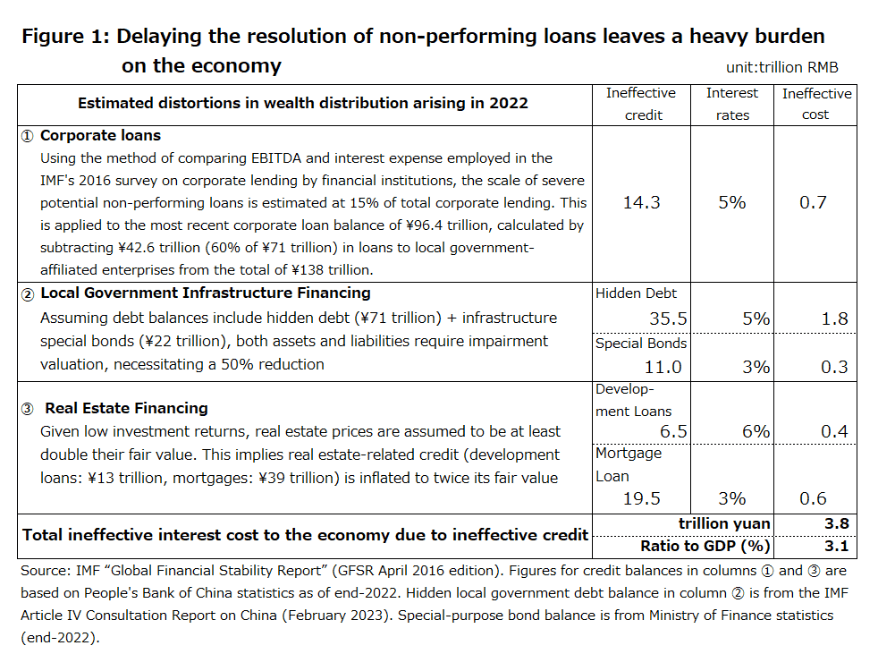
The interest paid on loans that should have been written off is essentially "financial unearned income." The author estimates that this abnormal transfer of wealth has grown to approximately 4 trillion yuan annually (≈equivalent to approximately USD 560 billion, or about 3% of China's GDP see Figure 1). This burden crowds out income that should go to regular economic activities, functioning like a heavy tax. Moreover, since the gains accrue to cash-rich state-owned enterprises and the wealthy via financial institutions, income inequality is further exacerbated.
4. Problems from Government-Skewed Wealth Distribution
From the 2010s onward, as local governments competed in debt- and investment-driven growth, wealth distribution shifted toward the broader "government sector," including state-owned enterprises (see Figure 2).
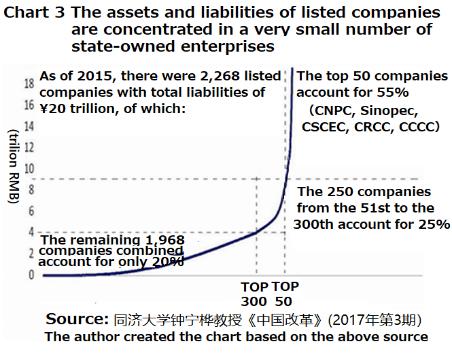
The leading cause was the subdivision of state-owned urban land-use rights. Over the past quarter-century of real estate boom, residential land prices multiplied many times over, generating huge capital gains for local governments. In addition, since the "4 trillion-yuan investment" stimulus launched in 2009, state-owned enterprises have also taken advantage of the bank lending system with privileges to carry out massive public works, causing their balance sheets to balloon (see Figure 3). Moreover, the most profitable prime contractor jobs for those projects were awarded to state-owned enterprises, further concentrating benefits.
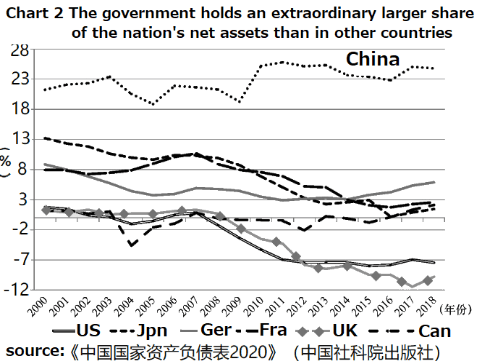
In terms of flows, the private economy dominates—accounting for 50% of tax revenue, 60% of GDP, 70% of R&D spending, 80% of employment, and 90% of the number of enterprises. However, in terms of stock, i.e., wealth ownership, the "government" sector—encompassing central and local governments, as well as state-owned enterprises—overwhelmingly dominates. This asymmetry means that, alongside the vast political power of the authoritarian system, the state's control over the economy is much stronger than in any other country. As government dominance has expanded, the role of market mechanisms has receded.
Seen from another angle, government-skewed wealth distribution means that private enterprises and households are left with too little wealth. Recently, authorities have been calling for "stimulating consumption." Still, without reforming this distributional imbalance, achieving consumption-led growth will remain difficult.
5. The Chinese Economy Slipping into Deflation
In the wake of the bursting bubble, China has fallen into a balance sheet recession, characterized by declining consumption and private investment. Reflecting weak domestic demand, consumer prices have hovered close to zero since the spring of 2023, while producer prices have been stuck between -2% and -4% since the autumn of 2022. The government proclaims that it will "promote a reasonable rise in prices through a moderately accommodative monetary policy" (Monetary Policy Implementation Report, Q2 2025). Yet, with price indices showing year-on-year declines, real interest rates remain elevated.
What is troubling is that despite the evident shortage of demand, the government continues to stress strengthening the supply side under the banner of "new quality productive forces." Moreover, the absence of the much-anticipated "revenge recovery" in consumption after the end of the COVID-19 pandemic in the spring of 2023 has quickly deepened public pessimism about the future.
When one witnesses the postponement of bubble clean-up, the balance sheet recession, and the public's pessimistic outlook together, it is hard to shake the impression that China is following the same path Japan did 30 years ago. Within such an atmosphere, there are growing concerns that a "deflationary mindset" — the belief that "prices will not rise" — is taking hold among the public. As Japan's experience has shown, once such a mindset takes hold, it is difficult to escape from it.
Meanwhile, amid sluggish demand, China's cheap exports — ranging from high-tech products to steel — have become an international issue. If such a massive economy were to turn into a deflation-exporting country, the rest of the world would not be spared its impact.
6. Still Room to Postpone the Adjustment
As described above, the circumstances surrounding the Chinese economy are severe. Yet, there is one saving grace: the outstanding balance of public bonds remains relatively low. In particular, the central government's outstanding national debt stands at only the mid-20% range of GDP, an exceptionally sound position as compared with other major countries. Moreover, China is now the world's third-largest net creditor nation after Germany and Japan. This means that even if the government issues more national bonds, they can be sufficiently absorbed by domestic savings. As Japan's precedent shows, such a country will not suddenly be forced into fiscal collapse; even if China continues to postpone dealing with the bubble, its economy is unlikely to face bankruptcy in the near term.
However, simply continuing large-scale government bond issuance without taking other measures could siphon off money, tighten financial markets, and lead to rising interest rates. To prevent this, one option would be to emulate Japan's "Kuroda-nomics" by having the central bank purchase vast amounts of outstanding national bonds from the market. Even if the People's Bank of China does not directly buy them, it can supply funds to the six major state-owned banks and have them purchase the bonds instead. In fact, over the past two years, three rounds of special government bond issuance, totaling approximately 2.3 trillion yuan, have been conducted. On each occasion, the central bank supplied liquidity through operations such as bond buy-backs. This gives the impression that a kind of "modified Kuroda-nomics" has already begun.
7. The Era of "China's Strength Lies in Science and Technology"
Although gloomy headlines overshadow the Chinese economy, there are also bright spots at the microeconomic level. One of them is that the era of "China's strength lies in science and technology" has arrived. In January 2025, the news of DeepSeek's success in AI development not only boosted the high-tech stock prices but also had such an impact that it lifted the overall mood of the Chinese economy, with many proclaiming that "China has broken through the U.S. technology blockade."
China has long been at the forefront of the IoT and the digital economy, and its electric vehicles (EVs) have evolved far beyond Western expectations, now posing a threat to the automobile industries of advanced economies. In addition, humanoid robots powered by AI — priced at around USD twenty thousand (per unit) — have appeared on the market, potentially triggering the next wave after EVs.
In the semiconductor industry, China has been dealt a significant blow by U.S. export restrictions. Still, it has turned this setback into a valuable lesson and is pushing hard to increase domestic production. Before long, China will likely capture a significant portion of the global low-end (volume) semiconductor market.
China is also strengthening its presence in cutting-edge basic research fields, including quantum computing and communications, life sciences, and maritime and space exploration. It has now become, both in name and in reality, the world's second-largest scientific and technological power.
Why China's Manufacturing Is the Strongest in the World
There are five reasons why China's manufacturing is considered the strongest globally: 1, an overwhelming abundance of science and engineering talent; 2, the world's most comprehensive supply chain; 3, a vast domestic market that enables economies of scale; 4, fierce domestic competition; and 5, the involvement of local governments.
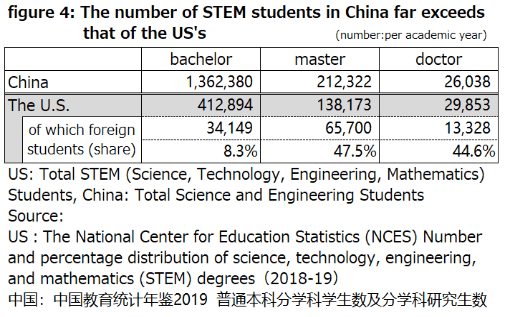
Among these, the first factor is particularly significant. As shown in Figure 4, China's superiority in the number of science, technology, and engineering (STEM) students is evident, even when compared with the United States, and a considerable share of U.S. students are, in fact, Chinese studying abroad. The flourishing of China's manufacturing industry is the result of the government's tireless efforts since the 1980s to promote science and technology.
Local Governments Distorting High-Tech Industries
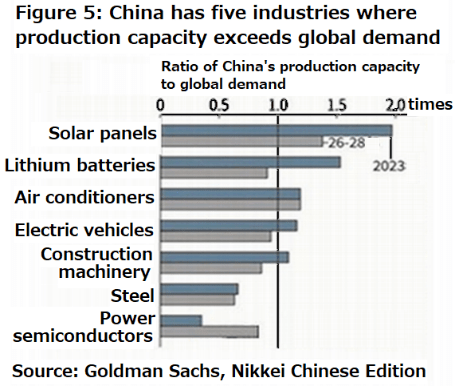
At the same time, one cannot ignore the negative impact of government involvement. Today, in five industries — solar panels, lithium batteries, EVs, and air conditioners — China's production capacity already exceeds total global demand (see Figure 5). In solar panels, capacity has swelled to twice the level of global demand. No sensible company or executive would usually enter an industry so severely plagued by overcapacity. Yet such extreme over-investment has occurred because of forces behind the scenes: local governments.
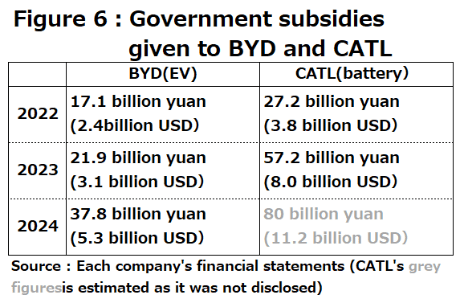
The reason lies in the mechanism of local public finances. Under China's tax system, half of the value-added tax paid by local enterprises goes to local governments (30–40% to municipalities). To increase their tax revenues, local governments have been providing massive subsidies to local firms (see Figure 6 for the cases of BYD in EVs and CATL in batteries). They select industries to nurture in line with central government industrial policies, resulting in concentrated and heavy investment in specific sectors. Recently, central authorities have been calling for the development of "new quality productive forces," and local governments have been enticing emerging firms by pledging investment from "industrial investment funds" that they have set up themselves. Without such backing, companies would not have engaged in reckless capital investment.
In recent years, suicidal price-cutting competition has spread, prompting the government to launch an "anti-involution" campaign to restrain excessive price cuts and investment races. However, the hidden culprit behind this cutthroat competition is local governments. Given today's unprecedented fiscal difficulties, it is easy to imagine local governments pressuring local enterprises for certain annual sales and tax targets. Firms, unable to refuse such desperate demands from local governments that have long supported them, resort to suicidal price cuts to meet those targets, and it is happening everywhere in China.
This problem is not confined to China. Importing countries, in an effort to protect their own industries, are increasingly resorting to anti-dumping measures. In this way, China's overcapacity problem has become, along with the "Reciprocal Tariff" wars initiated by the Trump administration in the United States, a factor driving the global free trade system toward fragmentation.
8. The Global Impact of China's Economic Trends
Measured at market exchange rates, China's GDP amounts to only about 63% of that of the United States. But on a purchasing-power-parity (PPP) basis, it actually exceeds the U.S., reaching 133% (according to IMF estimates for 2025). With the Chinese economy having grown to such proportions, its trajectory inevitably has an ever greater influence on the world economy. Below, we take up several issues, focusing in particular on those related to the problem of "Pax Sinica."
1. Changes in China's Trade and Investment Structure Amid U.S.-China Confrontation
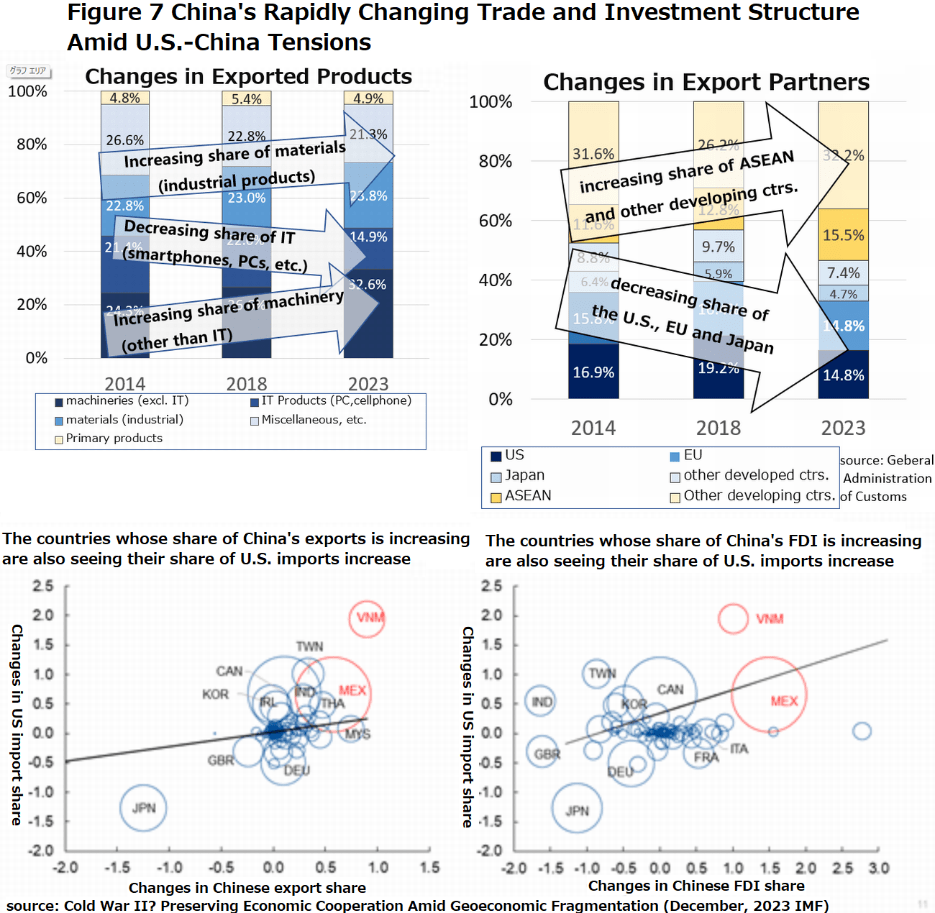
Over the past five years, geopolitical tensions between China and Western countries have intensified. Most notably, the strengthening of U.S. import barriers against China has profoundly affected the country's trade and investment structure. As a result of higher tariffs and other U.S. restrictions, Chinese assembly plants producing finished goods for export to the U.S. have relocated to ASEAN countries, Mexico, and Canada. Consequently, exports of finished goods to Western countries have declined.
At first glance, this appears to be "industrial hollowing-out." Yet, following these relocations, exports from China of parts, materials, and machinery to the relocated factories have surged. Thus, one can interpret this as "China's supply chain being extended overseas." In this way, the center of gravity of China's trade is shifting from "finished goods exports to advanced countries" to "intermediate goods exports to third countries where plants have relocated" (see Figure 7).
At the same time, Chinese companies are increasingly making foreign direct investments (FDI) in downstream operations such as finished goods assembly in ASEAN, Mexico, and Canada. Recent attention to Chinese EV makers' expansion into Southeast Asia reflects this broader trend of deepening and expanding entire China–ASEAN economic relations.
2. Recycling China's Huge Trade Surpluses
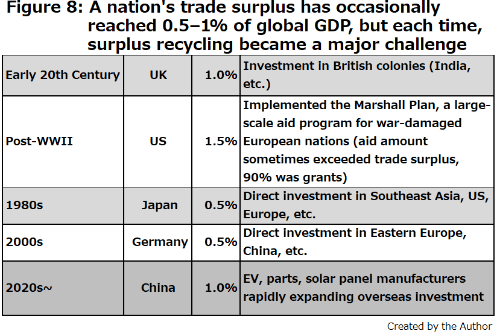
In 2024, China's sluggish domestic demand and weak imports resulted in a trade surplus of approximately one trillion U.S. dollars — roughly equivalent to 1% of global GDP (≈approximately $ 100 trillion). Such an occurrence is rare even in the past century. As shown in Figure 8, countries with massive trade surpluses in the past have recycled them through foreign direct investment. To prevent trade disputes from intensifying and financial crises in developing countries, China too must adopt appropriate strategies for recycling its surplus. As mentioned earlier, direct investments by Chinese firms - especially in EVs and auto parts -have been rapidly expanding in Southeast Asia and elsewhere. For Japanese automakers, this poses a threat; however, from a macroeconomic perspective of surplus recycling and the international circulation of capital, this development is both inevitable and necessary.
3. Can Overseas Investment Save the Chinese Economy?
Recently, some Chinese people changed their minds about Japan: Japan has long been seen as a country suffering from "lost decades" with stagnant GDP growth. But in fact, thanks to the massive FDI it accumulated over the years, Japan enjoys substantial investment revenue; viewed in terms of GNP (GNI), the country has not actually stagnated. The lesson many in China draw is that "China too should proactively pursue outward direct investment and transform itself into a country enriched by investment revenue, as Japan has done."
Indeed, in industries such as EVs and telecommunications, some Chinese firms are expected to grow into global brands, like Toyota in automobiles or Sony in its prime. However, challenges lie ahead. First, investments in "new quality productive forces" — such as solar panels, EVs, lithium batteries, and eventually some semiconductors — may face rejection in Western countries. Although Global South nations may welcome such investments, they are not yet the ultimate sources of demand.
Second, the Japan that China seeks to emulate took more than 30 years to build up its overseas investment assets. Along the way, it endured numerous painful failures and paid heavy tuition fees. Even successful investment projects take years to yield profits.
Currently, Japan's annual income from overseas investment is about 35 trillion yen, equivalent to 6% of its GDP. For China to generate profits equivalent to 6% of its GDP, it would need approximately 8 trillion yuan (≈$ 1.1 trillion) in investment income. In terms of sales, that would require three to five times as much — roughly 3 to 6 trillion USD. China's exports last year totaled approximately $ 3.58 trillion. Even if some exports are replaced by local production through FDI, if Chinese-branded products of that magnitude were also supplied via local production, one would need to consider whether global markets have sufficient consumption and absorptive capacity to accommodate both.
4. Excess Production Capacity and Its Major Impact on the World Economy
China accounts for about 18% of the world's total GDP (2024). If we isolate manufacturing, however, China's share is about 29% (2023)—exceeding the combined share of the top four countries (the U.S., Japan, Germany, and India)—showing how exceptionally manufacturing-heavy China's economy is.
The problem, then, is that several industries possess production capacity that exceeds not only China's domestic demand but also global demand—the issue of "excess production capacity." In recent years, as domestic demand has weakened and low-priced exports have increased, many of China's trading partners have initiated trade remedy measures, claiming that their own industries have been harmed by China's low-priced exports (see Figure 9).
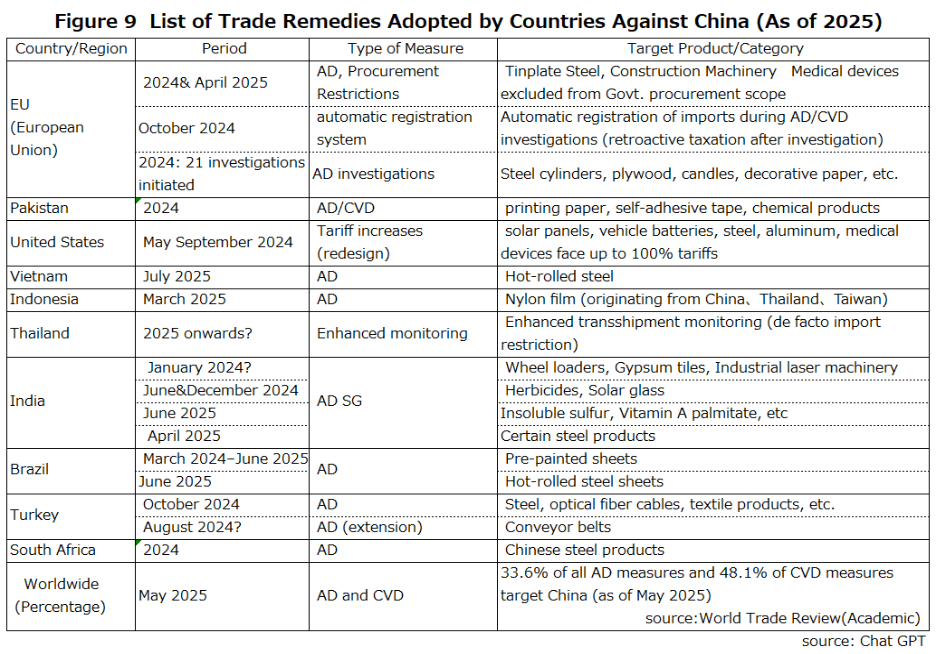
As discussed above, China is pursuing supply-side-heavy policies guided by the "new quality productive forces" agenda, further reinforced by China's tax system. Nor is there any prospect that China's weak domestic demand will be resolved quickly. Left unchecked, more countries will resort to trade-remedy measures. As more countries raise import barriers against particular Chinese products, goods left out will be diverted to those markets that remain open, intensifying industrial damage there; by its nature, this accelerates the spread of higher barriers. If China then retaliates, global trade will shrink further, making a "rerun of the 1930s collapse in trade" more than a theoretical risk. Thus, China's excess capacity problem, alongside U.S. reciprocal tariffs, threatens to shake the free-trade system itself.
An Idea: Voluntary Export Restraints by China
The author believes the above vicious cycle could be mitigated if China agreed to voluntary export restraints (VERs). The key is whether one can persuade China, and frame the case in terms of benefits for China as well: China can resolve disputes through the "negotiations" (谈判) that it prefers, rather than through unilateral measures by importing countries; Chinese firms could escape ruinous competition in which virtually no company makes a profit; and, where local governments ignore central directives for the sake of tax revenues, the central government could discipline exports through its powerful instrument of export licensing.
One should also stress that if China continues a relentless export offensive that eradicates industries in partner countries "in the name of competitiveness," it risks diplomatic isolation. For reference, I recently heard from a Chinese trade expert that, having listened to the EU insist it "must protect its auto industry," China began discussing a minimum export price arrangement for EVs with the EU counterpart, a positive sign for the future.
VERs are prohibited under Article 11.1(b) of the WTO Agreement on Safeguards. Still, the author considers this a "branches and leaves" issue. We should not, by insisting on that point, allow the entire "tree" of the free-trade system to wither outright.
5. The Outlook for U.S.–China Tariff Negotiations
At one point, Washington and Beijing both threatened tariffs in the triple digits, roiling the world's business. Since then, positions have softened: the U.S. side to 30% (including 20% tied to fentanyl-related sanctions) and the Chinese side to 10%, with deadlines repeatedly extended as talks continue. It is said that China's rare-earth export controls were highly effective in prompting significant U.S. concessions.
That said, more than rare earths, the decisive factor forcing the Trump administration to pull back its bluster may have been turbulence in U.S. financial markets: intensifying tariff warfare saw heavy selling of U.S. Treasuries and the dollar. Although U.S. equities subsequently reached record highs, markets still appear fragile, and this is likely to continue constraining the "China hawkish" stance of the Trump administration.
For China, with consumption and investment weak, a sharp decline in exports to its largest market—the United States—would be painful; it cannot simply "hold the line" indefinitely. Yet Beijing has few apparent concessions to offer: with weak domestic demand, a significant import expansion is unlikely. At the same time, it could increase direct investment in the U.S. Still, Washington's heightened security sensitivities limit how much it is willing to accept. An exchange rate adjustment, i.e., a negotiated yuan appreciation against the dollar, would be groundbreaking. However, given Beijing's conviction that "Japan fell into the Plaza Accord trap 40 years ago and suffered its ‘lost decades'," China is unlikely to accept exchange rate adjustments.
What, then, might the final deal look like? As of late August, it is hard to predict, but my base case is a "sensible adult solution" by both sides: China offers the utmost—but unglamorous—concessions while pressing to shave down as much as possible of the 20% tariff linked to fentanyl; Trump, seeking to embed U.S. commercial interests (including his own), trumpets China's unglamorous concessions with maximal rhetoric.
Within the administration, people say that there is tension between "Restrainers and China Hawks." Judging from the recent handling of tariff talks, export controls for chips to China, and the TikTok issue, Trump himself does not appear firmly aligned with the Hawks. Nor, given his desire to mediate in Ukraine (and court a Nobel Peace Prize) and to visit China to meet Xi Jinping, does he seem aligned with the Restrainers, who prefer avoiding foreign entanglements to focus on "America First." Ultimately, U.S.-China policy will likely follow the direction of Trump's own impulses.
9. Conclusion: No "Pax Sinica"
As argued above, the author is pessimistic about China's medium- to long-term economic future. While a sudden collapse is unlikely, given Xi Jinping's policy framework and governance style, stagnation in future appears unavoidable, and the "great rejuvenation of the Chinese nation" he proclaims will prove a mirage. I have long said "China's GDP will not overtake America's," and I see no reason to change that view for now. The only scenario that could overturn it would be an American forfeit: deepening domestic division or a rapid diffusion of AI causing massive unemployment among the middle class and above, plunging the U.S. into social chaos.
If "Pax Sinica" means that China becomes a hegemon that provides international public goods and supports global stability, as the U.S. has done, then a China unlikely to surpass the U.S. even in GDP will have almost no chance of becoming such a hegemon.
America's ability to lead rule-making and provide international public goods—such as a free-trade system—rested not only on overwhelming military power but also on its willingness to offer the world a vast market in which others could prosper, and on the postwar rise of the U.S. dollar as the key currency.
Crucial here is how, after World War II, the dollar displaced the pound sterling. With war-ravaged Europe's industrial capacity diminished and the U.S. commanding immense productive power, America in that period was primarily a seller, running huge trade surpluses. The U.S. then implemented the "Marshall Plan"—granting aid to Western Europe on a scale exceeding its trade surplus at one time (see Figure 10). This both gave Europeans the means to purchase U.S. goods—creating an outlet for America's massive productive capacity—and popularized dollar settlement, thereby promoting the dollar to gain the key-currency status.
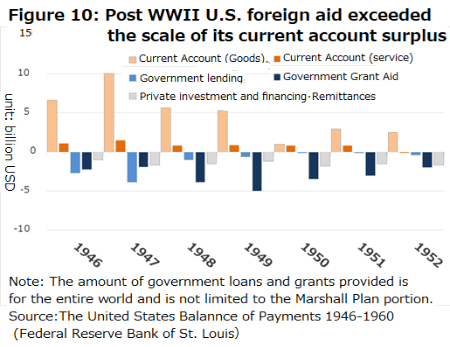
Once the U.S. gained that status, it acquired the privilege of expanding imports without worrying about its external balance of payment, effectively becoming the world's market, a country running massive trade deficits.
By contrast, although China proclaims that it "provides a vast market to the world," its $1 trillion trade surplus shows that it is, even more, a country to which the world provides a market. Far from "allowing others to prosper," China now faces accusations of "beggar-thy-neighbor" policies through low-price exports.
Could China reverse this by emulating the Marshall Plan and offering grants exceeding its $1 trillion surplus? Lavishing renminbi abroad would not only create outlets for excess capacity but also promote RMB use in international settlement, potentially paving the way to key-currency status.
Yet today's China has been unable even to forgive Belt and Road loans to poor countries, typically offering only maturity extensions—fearing domestic criticism for "throwing money down the drain." If Beijing were to "hand out renminbi that need never be repaid," it would face a domestic outcry: "If you have that money, spend it at home."
Thus, China is unlikely to become a hegemon that provides international public goods and supports global stability: not only is it unlikely to surpass the United States in GDP, but it also cannot dominate the global market, nor can it readily nurture the RMB into a key international currency.
A Prospect of Regional Hegemony
Upon entering his second term, President Trump revealed territorial ambitions toward Canada, Panama, and Greenland. Some refer to this as "territorial expansionism," but the author views it differently. In the early 21st century, the U.S. was an overwhelming hegemon capable of dominating the world; since then, its power has ebbed, and it now seems eager to assert that "the neighborhood is our turf." Interpreted this way, as the U.S. retreats from areas beyond its periphery, vacuums open up, and a scramble may ensue over who will dominate them.
For East Asia, Taiwan is definitely the focal point. Given the military dimension, Beijing's desired "cross-Strait unification" will not be easy to achieve. But if President Trump seeks a deal with Xi and appears ready to "sell out" Taiwan in exchange, the situation could become fluid.
More likely, however, is that Southeast Asia becomes "China's economic sphere of influence," reminiscent of the historical tributary system linking China and its neighbors. Will ASEAN drift into China's economic orbit?
As noted, the intensifying geopolitical confrontation with the U.S. has reshaped China's trade and investment structures, deepening and expanding economic ties between China and Southeast Asia—clearly supporting the "economic sphere" scenario. Yet ASEAN countries have a long history of navigating great-power rivalries with resilience; they are unlikely to submit meekly as vassals so easily.
Two variables will be decisive. The first is the depth of China's growth slowdown and stagnation. As both diplomatic aide and genuine economic benefits from the Chinese economy diminish, China's pull will fade. The second is how many like-minded partners—such as Japan, Europe, and others—can fill the vacuum left by the U.S., both militarily and economically. That said, if the relationship with China is framed solely as a geopolitical confrontation, the burden may exceed our capacity to handle. Alongside balancing strategies, efforts at cooperation and coordination with China are essential. In that sense, encouraging China to adopt voluntary export restraints to address excess capacity—and pursuing negotiated solutions—seems crucial to the author as noted in the above.
(Toshiya Tsugami, Director, Tsugami Toshiya's Works)
- May, 2026, "Religious Resurgence and Trump 2.0: Kirk's Legacy, University Control, and Immigration Management" by Yoshiyuki Kato, Professor, Rikkyo University
- May, 2026, "The Founding of America and Conspiracy Theories" by Tsuyoshi Kamimura, Associate Professor, Kwansei Gakuin University
- May, 2026, "Latin American Diplomacy under Trump 2.0: The Scope and Effectiveness of the "Western Hemisphere" Policy" by Suguru Osawa, Associate Professor, Aichi Gakuin University
- April, 2026, "Is Trump 2.0's Foreign and Security Policy Strategic?" by Tsuneo Watanabe, Senior Fellow, The Sasakawa Peace Foundation
- April, 2026, "The Trump Tariffs and Its Ramifications" by Yorizumi Watanabe, Professor Emeritus, Keio University
- April, 2026, "Donald Trump's Vision of the State and the Separation of Powers: An Analysis of His Tariff Policy" by Takeshi Umekawa, Professor, The University of Tokyo
- March, 2026, " Has U.S.–China Competition Eased under Trump 2.0? " by Ryo Sahashi, Professor, The University of Tokyo
- March, 2026, "Economic Security Under Trump 2.0 : A Shift in Values and Changing Options " by Kousuke Saitou, Professor, Sophia University
- March, 2026, " The Trump Administration's Economic Policies and the U.S. Economy: Risks Emerging in the U.S. Economy Amid Strong Equity Market and Economic Growth " by Masaharu Takenaka, Professor, Ryukoku University
- February, 2026, "The Impact of Russia-North Korea Military Cooperation on Regional Security" by Narushige Michishita, Vice President, National Graduate Institute for Policy Studies
- February, 2026, "The Sino-Russian Strategic Partnership and Japan's Security: Future Trajectories and Implications" by Shinji Yamaguchi, Senior Fellow, National Institute for Defense Studies
- February, 2026, "A Perspective on Russia's National Security Strategy: Focusing on the ‘Multipolar World,' ‘Anti-Westernism,' and ‘Nuclear Status'" by Shinji Hyodo, Vice President for Academic Affairs, National Institute for Defense Studies
- February, 2026, "The Possible Revival of "Imperial Russia" and What It Means for Asia and Japan" by Akio Kawato , Former DCM, Embassy of Japan in Russia
- February, 2026, "Russia After the Ukraine War: A Challenge to Japanese Security Strategy" by Matake Kamiya, Professor, The National Defense Academy
- January, 2026, "The Future of US-Russia Relations under Trump 2.0: Implications for Japan" by Taisuke ABIRU, Senior Research Fellow, the Sasakawa Peace Foundation
- January, 2026, "Hybrid Warfare Transformed Amidst the Ukraine War: Russian Tactics and the Global Diffusion of Threat" by Yoko HIROSE, Professor, Keio University
- October, 2025, "The End of Pax Americana and the Rise of China" by Nobuhiko Tamaki, Ph.D. Professor, Chuo University
- October, 2025, "China's "Kill ‘Three' Birds with One Stone" Approach to Deep-Seabed Resource Development" by Chisako Masuo, Professor, Kyushu University
- October, 2025, "Geopolitics of Science and Technology: China's Scientific Revolution vs. Trump 2.0" by Haruo Kurasawa, Science Journalist
- October, 2025, "China's Strategic Gains and Losses from the Ukraine and Middle Eastern Conflicts and Its Military Partnership with Russia" by Masafumi Iida, Director, Security Studies Department, The National Institute for Defense Studies
- October, 2025, "Medium- to Long-Term Prospects of the Chinese Economy" by Toshiya Tsugami, Director, Tsugami Toshiya's Works
- October, 2025, "China's Military Power as It Celebrates Its Centennial " by Bonji Ohara, Founder & Rep. Director, DEEP DIVE
- October, 2025, ""Pax China" from the Global South's Perspective" by Shin Kawashima, Professor, The University of Tokyo
- July, 2025, "What Makes Modi 3.0 Distinct and a Future Outlook" by Toru Ito, Professor, The National Defense Academy
- July, 2025, "Mid- to Long-Term Outlook for the Indian Economy: How to Assess the Indian Market―Benefits and Challenges of Japan-India Collaboration" by Go Yamada, Principal Economist, Japan Center for Economic Research
- July, 2025, "The India-China Border Issue and India's Military Strategy" by Satoru Nagao, Research Fellow, Hudson Institute
- July, 2025, "Where the India-Pakistan Conflict Is Headed" by Satoru Nagao, Research Fellow, Hudson Institute
- July, 2025, "India, a Leader in the Global South - What Is It Really Like?" by Tomoko Kiyota, Associate Professor, Nagasaki University
- July, 2025, "India's Diplomacy with the United States and Russia" by Mari Izuyama, Chief Research Fellow, National Institute for Defense Studies
- July, 2025, "Japan-India Security Cooperation in India's Grand Strategy" by Kazutoshi Tamari,Professor, Chukyo University
- July, 2025, "What's Next for Japan-India Strategic Partnership" by Kenji Hiramatsu, Former Ambassador to India
- April, 2025, "Outlook for the US Economy: Whether the "Golden Age" Is Beginning?" by Akihiko Yasui Director, Mizuho Research & Technologies, Ltd.
- April, 2025, "China's Economy Facing Internal and External Challenges" by Osamu Tanaka,Visiting Professor, Takushoku University
- April, 2025, "The Role of the Private Sector in Economic Security: Reflections from Japan-US and Public-Private Relations Perspectives" by Kohei Takeda Research Associate, Weatherhead Center for International Affairs at Harvard University
- April, 2025, "Proposal for Strengthening the Competitiveness of Japan's Defense Industry: Shift from the "Family Type" to the "Strategic Keiretsu-Type" System" by Yuzo Murayama Professor Emeritus, Doshisha University
- April, 2025, "Considering Economic Security Focusing on Food and Energy Security" by Takashi Sekiyama Professor, Kyoto University
- March, 2025, "An Outlook for the Japanese Economy" by Takao Komine, Visiting Professor, Taisho University.
- March, 2025, "Considering Social Security and Tax Reforms: What Will Become of Japan's Fiscal Reconstruction?" by Kazumasa Oguro, Professor, Hosei University.
- March, 2025, "Progress in Economic Security Policies and Further Strengthening of National Security Policy Integration Amid the Acceleration of "Securitization"" by Nobushige Takamizawa, Visiting Professor, The University of Tokyo.
- March, 2025, "From Economic Security to Geoeconomics" by Kazuto Suzuki, Professor, The University of Tokyo.
- January, 2025, "Healthcare Policy in the Second Trump Administration" by Takakazu Yamagishi Professor, Nanzan University.
- January, 2025, "Foreign and Security Policies of the Second Trump Administration" by Yuki Tatsumi Senior Fellow at the Stimson Center.
- January, 2025, "The Second Trump Administration and Japan-US Relations: Viewed by a Former Practitioner of Diplomacy" by Koji Tomita Former Ambassador to the United States.
- January, 2025, "The "FEAR" Returned: The Meaning of Trump's Reinstatement" by Koji Murata Professor, Doshisha University.
- December, 2024, "Analysis of the Trump Vote in the 2024 U.S. Presidential Election" by Takeshi Iida Professor, Doshisha University.
- December, 2024, "Trump's Victory Factors: Why Trump Wanted to Be President Again" byTsuneo Watanabe Senior Fellow, the Sasakawa Peace Foundation.
- December, 2024, "Kamala Harris and Factors Behind Her Defeat:Can the Democrats Make a Comeback?" by Masahito Watanabe Professor, Keio University.
- December, 2024, "American Democracy and Society Viewed from an Analysis of the 2024 US Presidential Election" by Takayuki Nishiyama Professor, Seikei University.
- October, 2024, "Assessment of Russia's Military Strength, Stockpiles, and Defense Production Base: Evaluating Russia's Capability to Continue Warfare" by Yu Koizumi, Associate Professor for RCAST, The University of Tokyo.
- October, 2024, "Germany's Arms Assistance for Ukraine: Has Its Culture of Self-Restraint Been Overcome?" by Norihide Miyoshi who served for The Japan News).
- October, 2024, "Russia's War Costs: Military Expenditures and Resource Allocation in "Wartime"" by Miho Okada, Professor, National Defense Academy.
- October, 2024, "Assessment of Russia's Military Strength, Stockpiles, and Defense Production Base: Evaluating Russia's Capability to Continue Warfare" by Yu Koizumi, Associate Professor for RCAST, The University of Tokyo.
- October, 2024, "Economic Sanctions and the Russian Economy" by Makoto Onozuka,Research Manager, Japan External Trade Organization.
- October, 2024, "Russia's Prolonged Military Invasion of Ukraine and Ukrainian Public Opinion: Focusing on Perceptions of Negotiations, Territory, and Sovereignty" by Tsuyoshi Goroku Associate Professor, Nishogakusha University.
- September, 2024, " The Russia-Ukraine War Viewed from War Termination Theory" by Yasuaki Chijiwa Chief Research Fellow, National Institute for Defense Studies.
- September, 2024, " How the Winter War Ended: A "Compromised Peace" Ends the Ukraine War?" by Tomoyuki Hanada Chief Research Fellow, National Institute for Defense Studies.
- September, 2024, " The End of the Soviet-Afghan War" by Takeshi Yuasa Professor, Sophia University Professor, Sophia University.
- July, 2024, " The Yoon Suk-yeol Administration and the ROK-Japan Relations" by CHOI, EunmiJ, The Asan Institute for Policy Studies, Research Fellow.
- July, 2024, " The 22nd National Assembly Election and South Korean Politics " by Hideki Okuzono, Professor, University of Shizuoka.
- July, 2024, " South Korea's Economic Security Policy and New Japan-ROK Economic Cooperation" by Satoru Okuda, Professor, Asia University.
- July, 2024, " Japan-ROK Cooperation: Not an Option but a Must" by Chey Tae-won, Chairman and CEO SK Inc.
- July, 2024, "Examining the Yoon Administration's Foreign Policy over the Past Two Years " by Junya Nishino, Professor, Keio University
- July, 2024, "North and South Korea Enter a New Phase of Competition" by Narushige Michishita, Executive Vice President and Professor at the GRIPS.
- July, 2024, "The Camp David Summit and U.S.-Japan-ROK Security Cooperation" by Yasuyo Sakata.
- April, 2024, "The Middle East Question and Japan" by Sinan Levent, Professor, Ankara University
- April, 2024, "The Israel-Hamas War and the Disruption of the Rules-Based International Order-Viewed from Theories of International Politics-" by Matake Kamiya, Professor, National Defense Academy of Japan
- March, 2024, " Regional Political Dynamics in the Middle East - Factors Changed and Remained unchanged after the October 7th Incident-" by Amane Kobayashi, Senior Researcher, the Institute of Energy Economics, Japan
- March, 2024, "The Ukraine War and Russia's Changing Middle East Diplomacy " by Taisuke Abiru, ,Senior Research Fellow, the Sasakawa Peace Foundation
- March, 2024, "Superpowers' Engagement with the Middle East and Their Intentions " (Edited lecture transcript) by Koichiro Tanaka, Professor, Keio University
- March, 2024, " Why the Israel-Hamas War Broke Out?" by Hiroyuki Suzuki, Professor, Associate Professor, The University of Tokyo
- March, 2024, " The Middle East Peace Process-Its Development and Future " by Chie Ezaki, Associate Professor, National Defense Academy of Japan
- March, 2024, "The Origin and Prospects of the Question of Palestine -Transformation of Israeli Politics and "10/7" as a Boiling Point- " by Aiko Nishikida, Professor, Keio University
- January, 2024, "Indonesia's Global South Diplomacy and Its Impact on Domestic Politics" by Jun Honna, Professor, Ritsumeikan University
- January, 2024, "Brazilian Foreign Policy and the Global South" by Hiroyuki Urabe, Professor, Dokkyo University
- January, 2024, "Africa's Population Explosion:How the "Last Frontier" Will Change the World" by Keiichi Shirato, Professor, Ritsumeikan University
- January, 2024, "The Impact of PM Modi's Global South Policy on the Military Strategy of India" by Satoru Nagao, Research Fellow, Hudson Institute
- December, 2023, "The Global South Concept and Its Historical Development and Outlook" by Ken Jimbo, Professor, Keio University
- December, 2023, "India's Global South Diplomacy and Japan" by Toru Ito, Professor, National Defense Academy
- December, 2023, "The Global South Viewed from China's Perspective" by Shin Kawashima, Professor, the University of Tokyo
- October, 2023, " Political and Social Divide in the United States and Challenges for Democracy" by Kazuhiro Maeshima, Professor, Sophia University
- October, 2023, " Has US Foreign Policy Doctrine Changed? " by Tsuneo Watanabe, senior Fellow, Sasakawa Peace Foundation
- October, 2023, " America's Journey to Hegemony and Its Challenges" by Koji Murata, Professor, Doshisha University
- September, 2023, " A Medium- to Long-Term Outlook for the US Economy―Can America Win the Competition with China?―" by Tatsuhiko Yoshizaki, Chief Economist, Sojitz Research Institute, Ltd.
- September, 2023, " China's Strategy toward the U.S " by Toshiya Tsugami, Adjunct Researcher, the Japan Institute of International Affairs
- September, 2023, " The Deepening Security Dilemma in US-China Relations " by Ryo Sahashi, Associate Professor, the University of Tokyo
- July, 2023, "How Would North Korea and China Use Nuclear Weapons? -- Scenarios for Discussion" by Narushige Michishita, Professor at the National Graduate Institute for Policy Studies
- July, 2023, "Japan's Nuclear Strategy" by Nobukatsu Kanehara, Visiting Professor at Doshisha University
- July, 2023, "G7 Hiroshima Summit and Efforts for a Safer World Without Nuclear Weapons" by Nobushige Takamizawa, Visiting Professor at the University of Tokyo
- July, 2023, "Roundtable Discussion—Let's Talk Frankly About Nuclear Issues" by SSDP Discussion Members
- June, 2023, "Exploring the Possibility of Nuclear Attacks on Japan-Nuclear Simulations in the Era of "Three-Front Nuclear Threats" by Hiroyasu Akutsu, Professor, Heisei International University
- June, 2023, "China's Aim to Become a Nuclear Superpower" by Masafumi Iida, Head of China Division at the National Institute for Defense Studies
- June, 2023, "Challenges for Nuclear Arms Control in the Era of Strategic Competition Among Major Powers" by Nobumasa Akiyama, Professor, Hitotsubashi University
- June, 2023, "Mechanisms and Functions of Nuclear Deterrence-Development of US Nuclear Strategic Theory" by Masashi Murano, Research Fellow of Hudson Institute
- April 2023, "Changing NATO's "Achilles Heel"—Security in the Baltic Region" by Sanshiro Hosaka, Fellow,The International Centre for Defence and Security, Estonia
- April 2023, Evolution of European Security System - Visualization of Deterrence by NATO and the "Russian Problem" by Michito Tsuruoka, Associate Professor, Keio University
- April 2023, "An Expanded NATO's Nuclear Strategy" by Yoko Iwama
- March, 2023, "Germany's Civilian Power Model—Modification or Termination?--Germany Struggling with the War in Ukraine" by Toshiya Nakamura, Professor, Nagoya University
- March, 2023, "France and the Ukraine War―The Logic Behind Macron's Security Policy" by Ken Endo, Professor, The University of Tokyo
- March, 2023, "The Russo-Ukrainian War and the British Response: 2014-2023" by Yuichi Hosoya, Professor, Keio University
- March, 2023, "Where is America Heading—Implications and Challenges for the Allies" by Koji Murata, Professor, Doshisha University
-
December 2022, Proposal "Defending Our Country – Defense Policy in a New Cold War Era" was announced
- Front Cover
- Changes in the Security Environment Surrounding Japan - Shifting Power Balance and the Three Front Threats Ken Jimbo
- How Will "Japan Contingencies" Emerge? Osamu Onoda
- The Japan-US Alliance Revisited: Is it Dependable? Chikako Kawakatsu Ueki
- A New Phase of Defense Diplomacy and Defense Production and Technology Base Ippeita Nishida, Tsuneo Watanabe
- Intelligence Activities in the Post-Ukraine War Era Jun Nagashima
- Responding to the Nuclear Threat Masashi Murano
- No Time to Lose for Improving Japan's Defense Capabilities - Can the JSDF Defend the Homeland? - Ryoichi Oriki
- Toward the Formulation of a New "National Security Strategy" Hideshi Tokuchi
- October 2022, "Japan-China Relations under the Long-term Administration of Xi Jinping: Current Status, Prospects, and Expectations" written by Kazuyuki Suwa, Professor, University of Shizuoka
- October 2022, "China's Policy on the Global South --- China's World View and the Configuration of the US-China Confrontation " written by Shin Kawashima, Professor, the University of Tokyo
- October 2022, "Military Strategy of Xi Jinping's China" written by Bonji Ohara, Senior Fellow, Sasagawa Peace Foundation
- September 2022, " Social Governance by the Communist Party of China: The Present State and the Future Prospects " written by Kazuko Kojima, Professor, Keio University
- September 2022, "The Relationship between Domestic Politics and Diplomacy under the Xi Jinping Administration- Why Were the Large-Scale Military Exercises Decided?" written by Chisako T. Masuo, Professor, Kyushu University
- September 2022, "Xi Jinping's China--- Prospects for Its Climate Change Policy ---" written by Takashi Sekiyama, Associate Professor, The University of Kyoto
- August 2022, " Current Assessment of the Xi Jinping's Rule and Prospects for the Third Term of the Xi Administration " written by Takashi Suzuki, Associate Professor, Aichi Prefectural University
- August 2022, " Economic Challenges Awaiting the Xi Jinping Administration As it Enters its Third Term" written by Toshiya Tsugami, Director, Tsugami Toshiya's Works
- July 2022, "The Russian Invasion of Ukraine and the Future International Legal Order" written by Masahiro Kurosaki, Associate Professor, National Defense Academy
- July 2022, "The Ukraine War and Security in East Asia" written by Narushige Michishita, Vice President, National Graduate Institute for Policy Studies
- July 2022, "How Will the Ukraine War Change the New US-China Cold War?" written by Yasuhiro Matsuda, Professor, the University of Tokyo
- July 2022, "Impact of the Ukraine War on the Global Economy" written by Tatsuhiko Yoshizaki, Chief Economist, Sojitz Research Institute, Ltd.
- June 2022, "Why War Occurs in Europe?--The Structural Transformation of the European Security Order in the Post-Cold War Era --" written by Yuichi Hosoya, Professor, Keio University
- June 2022,"The Russia-Ukrainian War and the Behind-the-Scenes Stance of the United States" "On Economic Security" written by Tsuneo Watanabe, Senior Fellow, Sasakawa Peace Foundation
- June 2022, "The Russia-Ukraine War and NATO", written by Michito Tsuruoka, Associate Professor, Keio University
- June 2022, "The Ukrainian War Viewed from Theories of International Politics" written by Matake Kamiya, Professor, National Defens Academy
- March 2022, "Economic Security Challenges and Cyber Security" written by Jun Osawa, Senior Research Fellow, Nakasone Peace Institute
- March 2022, "On Economic Security" written by Matake Kamiya, Professor, the Ntional Defense Academy
- March 2022, ""Economic Security" and the Review of the 2013 NSS and the Related Strategy Documents" written by Nobushige Takamizawa, Visiting Professor, the University of Tokyo
- March 2022, "The US-China Rivalry and Economic Security" written by Yuzo Murayama, Professor, Doshisya University
- March 2022, "Japan's National Security Policies and Science and Technology" written by Nobukatsu Kanehara, Professor, Doshisya University
- March 2022, "Economic Security in the Free Trade Regime" written by Kazuto Suzuki, Professor, the University of Tokyo
- January 2022, "The 2022 South Korean Presidential Election and the Next Administration's Foreign and Security Policy" written by Junya Nishino, Professor, Keio University
- January 2022, "North Korea's Nuclear and Missile Development and Japan's Defense" written by Hideshi Tokuchi, Senior Fellow, GRIPS
- January 2022, "What will Become of Japan-South Korea Relations? The 1965 Japan-South Korea Treaty System in Jeopardy" written by Masao Okonogi, Professor Emeritus, Keio University
- December 2021, "Economic and Social Conditions in North Korea and its Relations with South Korea" written by Mitsuhiro Mimura, Chief Research Fellow, The Economic Research Institute for Northeast Asia.
- December 2021, "China's Korean Peninsula Policy and North Korea" written by Shin Kawashima, Professor, the University of Tokyo.
- December 2021, "China's Korean Peninsula Policy and North Korea" written by Shunji Hiraiwa, Professor, Nanzan University.
- December 2021, "What to Do with the Relations with North Korea?" written by Hitoshi Tanaka, Chairman for Institute for International Strategy at the Japan Research Institute.
- October 2021, "Strategic Implications of North Korea's Enhanced Nuclear and Missile Capabilities" written by Narushige Michishita, Vice President, National Graduate Institute for Policy Studies.
- October 2021, "The Biden Administration's North Korea Policy: Its Low Priority and Looming Crises" written by Tsuneo Watanabe, Senior Fellow, Sasakawa Peace Foundation.
- October 2021, "The Evolution of the US-ROK Alliance: Tasks in the Biden Era" written by Yasuyo Sakata, Professor, Kanda University of International Studies.
- September 2021, "The Development of Regional Security Architecture: From Asia-Pacific to Indo-Pacific" written by Ken Jimbo, Professor, Keio University.
- September 2021, "The Strategic Development of Japanese Security Cooperation under Superpower Competition and the Development of the FOIP and its Operationalization" written by Nobushige Takamizawa, Visiting Professor, Graduate School of Public Policy, The University of Tokyo.
- August 2021, "Security Perceptions of Central Asian Countries--- From the Perspective of China Studies ---" written by Shin Kawashima, Professor, the University of Tokyo.
- August 2021, "Security in the Indian Ocean Region---Implication of the Galwan Incident for QUAD in the Indo-Pacific" written by Dr. Satoru Nagao, Fellow (Non-Resident), Hudson Institute.
- August 2021, "Easternization and Security in Asia" written by Tsuneo Watanabe, Senior Fellow, Sasakawa Peace Foundation.
- July 2021, "The Ideas of "Autonomy" and "Self-Reliance" in Contemporary India's Foreign Strategy" written by Kazutoshi TAMARI, Associate Professor,Chukyo University.
- July 2021, "Thailand's Security Policies and Threat Perceptions" written by Saya Kiba, Associate Professor, Komatsu University, Faculty of Intercultural Communication.
- July 2021, "Myanmar's Security Perceptions and the February 1 Coup d'Etat" written by Yoshihiro Nakanishi, Associate Professor, Kyoto University.
- July 2021, "Australia's Security Perceptions and the "Asia Threat"" written byTomohiko Satake, Senior Fellow, Defense Policy Division, Policy Studies Department, NIDS .
- June 2021, "The Indo-Pacific Regional Architecture: Its Future--- Multipolar Order Beyond US-China Relations ---" by Tsutomu Kikuchi, Professor, Aoyama Gakuin University
- June 2021, "The Quad Plus in the Security of Asia: Its Significance and Outlook" by Hideshi Tokuchi, Senior Fellow, National Graduate Institute for Policy Studies
- June 2021, "Indonesian Views and Perceptions on National Security" by Nobuhiro Aizawa, Associate Professor, The Graduate School of Social and Cultural Studies, Kyushu University
- June 2021, "Normalized Tensions in the Cross-Strait Relations--- Structural Changes in Taiwanese Society and the Xi Jinping Administration's Strategic Shift ---" by Yasuhiro Matsuda, Professor, The University of Tokyo
- June 2021, "China's Maritime Strategy and Responses of the United States and Japan" by Yoji Koda, Former Commander in Chief, Self Defense Fleet
- June 2021, "The South China Issues from the Perspective of the International Law Order",by Shigeki Sakamoto, Emeritus Professor, Kobe University
- May 2021, "Indonesian Views and Perceptions on National Security" by Nobuhiro Aizawa, Associate Professor, Kyushu University
- May, 2021, "The Philippine Foreign and Security Policy Perspective" written by Yusuke Takagi Associate Professor,National Graduate Institute for Policy Studies.
- May, 2021, "Vietnam's Security: Challenges and Responses" written by Tomotaka Shoji Head, Asia and Africa Division, Regional Studies Department, National Institute for Defense Studies
- March, 2021, "Can the Biden Administration Restore America as a Global Leader?" written by Matake Kamiya, Professor, the National Defense Academy of Japan.
- March, 2021, "The Biden Administration and Japan's Security Strategy" written by Hideshi Tokuchi, Senior Fellow, National Graduate Institute for Policy Studies.
- February,2021, "US Foreign and Security Policy Direction Viewed from the Biden Administration's Lineup" written by Tsuneo Watanabe, Senior Fellow, Sasakawa Peace Foundation
- February,2021, "Trade Policies of the Biden Administration" written by Takaaki Asano, Senior Analyst, Sumitomo Corporation Global Research Co. Ltd.
- February,2021, "The Biden Administration's Policy toward Russia" written by Taisuke Abiru, Senior Fellow, Sasakawa Peace Foundation
- January,2021, "Will US Policy Toward China Change?" lectured by Ryo Sahashi, Associate Professor, the University of Tokyo
- January,2021, "How will China View the Biden Administration?" written by Bonji Ohara, Senior Fellow, Sasakawa Peace Foundation
- January,2021, "An Assessment of the 2020 US Presidential Election-American Democracy Now-" lectured by Fumiaki Kubo, Professor, the University of Tokyo
- January,2021, "Two Trumpian Mysteries-Why did Trump win over 70 million votes? Why is his outrageous behavior unchecked?-" lectured by Kazuhiro Maeshima, Professor, Sophia University
- September, 2020, "The Novel Coronavirus (COVID-19) Pandemic and Internationa Relationsl" by Matake Kamiya, Professor, National Defense Academy of Japan
- September, 2020, "The Policy Agenda for the Xi Jinping Administration- COVID-19 Countermeasures and China's International Relations -" by Shin Kawashima, Professor, The University of Tokyo
- "Control in the United States and International Relations" by Koji Murata, Professor, Doshisha University
- September, 2020, "The EU's Response to COVID-19 and International Relations" by Yuichi Hosoya, Professor, Keio University
- August, 2020, "The Corona Crisis Seen from a Macroeconomic Perspective" written by Motoshige Itoh, Professor Emeritus, The University of Tokyo
- August, 2020, "The Coronavirus Pandemic and Japan's Infectious Disease Control" written by Takashi Mihara, Senior Research Fellow, NLI Research Institute
- August, 2020, "Infectious Disease Crisis Control in Japan- Recommendations on an Exit Strategy -" written by Kazumasa Oguro, Professor, Hosei University
- August, 2020, "Security against Infectious Disease Threats --- Policy Responses Abroad" written by Takashi Sekiyama, Associate Professor, Kyoto University
- June 2020,"Transformation of the International Order in the Middle East--- Varying Degrees of "Stateness" and Three Directions of the New Order" written by Satoshi Ikeuchi, Professor, Research Center for Advanced Science and Technology, The University of Tokyo
- June 2020,"Destabilization in the Middle East and its Impacts on Japan's Energy Security" written by Amane Kobayashi, Research Fellow, The Institute of Energy Economics
- May 2020: Urgent Recommendations "Toward a V-shaped Recovery after the Novel Coronavirus Pandemic "Coronavirus Testing for All" --- the First Step of the Next Phase"
- May 2020: "US Diplomacy toward Iran: Economic Sanctions as a Diplomatic Tool" Hiroki Sugita Columnist, Kyodo News
- "Russian Factors in the Middle East" Taisuke Abiru Senior Research Fellow, Sasakawa Peace Foundation
- "The SDF Dispatches to the Middle East --- History and Significance" Ippeita Nishida Senior Research Fellow, Sasakawa Peace Foundation
- March 2020, "Space and Security" Kazuto Suzuki Professor, Hokkaido University
- March 2020, "The US Security Space Policy --- With a Focus on the Establishment of Two Space Forces" Yasuhito Fukushima Chief Researcher, The National Institute for Defense Studies
- March 2020, "China's Recent Activities in Space and Cyberspace" Bonji Ohara Senior Research Fellow, Sasakawa Peace Foundation
- March 2020, "Environmental Security and Japan" Takashi Sekiyama Associate Professor, Kyoto University
- March 2020, "Changes in Global Environment and Security --- US Security Strategy" Hideshi Tokuchi Senior Fellow, National Graduate Institute for Policy Studies (GRIPS)
- February 2020, "Cyberspace Security" Motohiro Tsuchiya Professor, Keio University
- February 2020, "Japan's Space and Cyberspace Policy" Yukinari Hirose Former President of the National Institute for Defense Studies
- December 2019, "The US-China Confrontation --- Where Will Hegemony Reside Next?" Akio Takahara Professor, the University of Tokyo
- December 2019, "Challenges Facing the Chinese Economy" Osamu Tanaka Chief Senior Researcher, Institute of Developing Economies, JETRO
- December 2019, "US Strategic Perception on China: Implications for US Allied Partners" Tsuneo Watanabe Senior Fellow, Sasakawa Peace Foundation
- November 2019, "The Xi Jinping Administration's View of the International Order– China's emphasis on United Nations diplomacy and liberal economic policies−" Shin Kawashima, Professor, the University of Tokyo
- November 2019, "The Future of China's Security Strategy" Hideshi Tokuchi, Senior Fellow, National Graduate Institute for Policy Studies
- November 2019, "China --- Its Confidence and Anxiety" Bonji Ohara, Senior Research Fellow, Sasakawa Peace Foundation
- August 2019: Several Perspectives on the Korean Peninsula Issue--- The Deteriorating Japan-South Korea Relationship and the Uncertain Denuclearization of North Korea --- By Masahiro Akiyama Chairman, the SSDP
- July 2019, "An Outlook on the Denuclearization of North Korea--- What is the Stance of North Korea?---", Junya Nishino, Professor, Keio University
- July 2019, "An Outlook on the Denuclearization of North Korea --- How will the US move?", Narushige Michishita, Vice President, National Graduate Institute for Policy Studies
- July 2019, "Discussion on Denuclearization of North Korea", SSDP Discussion Meeting on May 8, 2019
- May 2019: "Current Status and Prospects of South Korea and Japan's Frictions over History: How to address the Judicial Problems", Masao Okonogi, Professor Emeritus, Keio University
- May 2019: "South Korea and Japan's Frictions over History" (Comments), Junya Nishino, Professor, Keio University
- May 2019: Japan and South Korea Relationships (Question & Answer)
- March 2019: "The Present State and Prospects of the Indian Economy and Economic Policies" written by Koji Kobayashi, Senior Economist Mizuho Research Institute Ltd.
- March 2019: "The "Modi diplomacy" in the History of Indian diplomacy--- Departure from or maintenance of the traditional diplomacy? ---" written by Toru Ito, The National Defense Academy of Japan
- February 2019: Dynamics of Indian Politics and the 2019 General Elections, written by Chiharu Takenaka, Professor of Rikkyo University
- February 2019: "Cooperative Strategy" to Realize "Competitive Strategy"--- The composite structure of Japan's "Free and Open Indo-Pacific" strategy (vision) ---, written by Matake Kamiya, Professor at The National Defense Academy of Japan
- January 2019:, A paper, "How will the US midterm elections results affect the Trump administration's foreign policy for 2019?" written by Tsuneo Watanabe, Senior Fellow, the Sasakawa Peace Foundation
- January 2019:, A paper, "The Present and Future of the International Trade Order" , written by Akihiko Tamura, Professor, National Graduate Institute for Policy Studies
- December 2018: The US-China Competition and Japan, written by Ryo Sahashi, Professor at Kanagawa University
- December 2018: An Outlook for the US-China Trade War―What makes the two economically interdependent superpowers confront each other?―, written by Takashi Sekiyama, Associate professor at Toyo University
- September 2018: Proposal, "The Denuclearization of North Korea and the Restoration of Peace in the Korean Peninsula― Correct Perceptions and Eight Proposals on Japan's North Korea Diplomacy-" edited by the Society of Security and Diplomatic Policy Studies
- September 2018: "The Taiwan Policy of the Xi Jinping Administration in its Second Term: An Outlook on Cross-Strait Relations in the New Era" written by Yasuhiro Matsuda, Professor of the Tokyo University
- July 2018: "The EU States and Russia on North Korea Issues- Expansion of Influence through Diplomacy: Attempts and Limitations -" lectured by Yuichi Hosoya, Professor of Keio University
- "An Assessment of the US-North Korea Summit and an Outlook for the Future of the Korean Peninsula" lectured by Junya Nishino, Professor of Keio University
- "Korean Peninsula Issue and Japan's Future Security Policy" written by Hideshi Tokuchi, Senior Fellow of National Graduate Institute for Policy Studies
- July 2018: "US North Korea policy affected by personnel changes in the Trump administration" lectured by Tsuneo Watanabe, Senior Fellow of the Sasakawa Peace Foundation.
- "China-North Korea relationship under Xi Jinping" lectured by Shin Kawashima, Professor of the Tokyo University.
- "North Korean Denuclearization and Russia" lectured by Nobuo Shimotomai, Professor of the Hosei University.
- March 2018: "The Network Hegemony Theory for a Security Architecture in The Asia Pacific Region" lectured by Masahiro Akiyama, Chairman, the Society of Security and Diplomatic Policy Studies
- January 2018: "A Destabilized Middle East" lectured by Koichiro Tanaka, Professor, Keio University
- December 2017: "Problems in Sino-Japanese Relations, 1992-2042" lectured by Ezra F. Vogel, Professor of the Social Sciences Emeritus at Harvard University
- November 2017: "The Future of the Asia-Pacific Region" written by Yoriko Kawaguchi, Fellow, the Meiji Institute for Global Affairs, Former Minister Foreign Affairs
- October 2017: "A New Trend in India's Foreign Policy and Japan" Written by HIROSE,Takako, Professor, Senshu University
- August 2017: "The Shocks that shook the Transatlantic World and their Implication for Japan's Foreign Policy" written by HOSOYA, Yuichi, Professor, Keio University
- August 2017: "Does Economic Interdependence not Encourage Collaboration? ―Thinking Japan-China Relations from an Economic Perspective―" written by Takashi SEKIYAMA, Ph.D., Toyo University
- July 2017: Proposal article "The Trump Administration's Impact on the Cross-Strait Relations" written by Yasuhiro Matsuda, Ph.D.
- June 2017: Proposal article "The outlook for the relationship between two great powers and implications for Japanese diplomacy" written by Professor Shin Kawashima
- May 2017: (Emergency Proposal) Facing the Inconvenient Truth: Re-examining Policy for Peace and Denuclearization of the Korean Peninsula (Chief author, Masao Okonogi)
- March 2017: "Economic Influences of the Trump Administration" written by Professor Motoshige Ito
- February, 2017: Proposal article "Trump's Foreign and Security Policy - Unpredictable President, Realistic Secretaries - " written by Mr. Tsuneo Watanabe is posted on the website of SSDP.
- December, 2016: Proposal article "Reconsidering North Korea Policy: How to Deal with a Nuclear Armed Divided States" written by Professor Masao Okonogi is posted on the website of SSDP.
- Japan-Korea Dialogue for AI Cooperation on April 3, Imperial Hotel
- Taiwan-Japan Round Table on August 24th, at Capital Tokyu Hotel
- Japan-Korea Political Leaders Dialogue was held on February 10th,2023 at International House of Japan
- March 2022, A remembrance seminar "Remembering Professor Ezra Vogel" held on January 17, 2022
- March 2021, Japan-ROK Parliamentary Dialogue -Japan-ROK Cooperation in the Era of US-China Competition- held on March 11, 2021
- December 2020: The report of the Japan-ROK Future Dialogue held on November 21 to discuss "Japan-ROK Cooperation in the Post-Covid-19 Era
- October 2020: "Responses to COVID-19 and Agendas for the Post-COVID-19 Era", A Brief Overview of the Japan-Korea Experts Dialogue held on July 29,30, 2020
- October 2020: "The China-Taiwan Confrontation over Corona Response and Taiwan's Security" written by Makoto Ogata, Former Chief of the Japan-Taiwan Exchange Association in Taipei
- May 2020: "Rivalries in the Middle East in New Security Dynamics", Written by Sayed Ghoneim, Major General (retired) of the Egyptian Armed Forces, Chairman, Institute for Global Security & Defence Affairs
- March 2020: The Japan-South Korea Relationship in a Cul-de-Sac--- Where is an Exit ? Masao Okonogi Professor Emeritus, Keio Universit
- December 2019: The Hong Kong Upheaval and the Future of Cross-Straits Relations-The 2019 Japan-Taiwan Strategic Dialogue Report OGATA, Makoto Former Chief of the Japan-Taiwan Exchange Association in Taipei
- August 2019: Report; 2019 FUTURE CONSENSUS DIALOGUE --Sustainable Prosperity and Future of Korea-U.S.-Japan Cooperation-- By Future Consensus Institute (Yeosijae)
- June 2019: Report on India – Japan Security Dialogue 2019 by Ms. Vindu Mai Chotani, Ph.D Student, The University of Tokyo
-
June 2019: Four papers on Japan-India Cooperation submitted to India-Japan Security Dialogue 2019
-
Japan's Rationale for a Free and Open Indo-Pacific Vision
Tsuneo Watanabe, Senior Fellow, The Sasakawa Peace Foundation -
The Significance and Possibilities of India-Japan Cooperation in the Concept of the Indo-Pacific
Toru ITO Associate Professor, National Defense Academy of Japan -
Japan-India Defense Cooperation in the Indo-Pacific Context - Operationalizing the Security Aspect of the Indo-Pacific Vision –
Hideshi Tokuchi, Senior Fellow, National Graduate Institute for Policy Studies (GRIPS) -
India-US-Japan Defense Cooperation: What's next?
Dr. Satoru Nagao, Hudson Institute
-
Japan's Rationale for a Free and Open Indo-Pacific Vision
- November 2018: "The Present State of the Japanese Economy and Policy Issues" lectured by Motoshige Itoh, Professor Emeritus at the University of Tokyo.
- November 2018: "Expanding Social Security Expenses and Fiscal Reforms" lectured by Kazumasa Oguro, Professor at Hosei University.
- September 2018: "Taiwan Identity and Cross-Strait Relations and Trump's Taiwan Policy and the Future of Taiwan-US Relations-Discussion at The Second Japan-Taiwan Strategic Dialogue (June 21, 2018, Taipei)-" written by OGATA, Makoto
- September 2018: "Japan-Taiwan Dialogue 2018 Minutes", 21st June 2018, Taipei, Taiwan.
- July 2018: Report on The Second Japan – Philippines Strategic Dialogue prepared by Ms. Vindu Mai Chotani, Ph.D. Student, Graduate School of Public Policy, Tokyo University.
- May 2018: "Civilian Control "at Crisis"? – Perhaps Not, for the Case of the Field Sit-reps from SDF's South Sudan Mission" reported by Ippeita Nishida, Research Fellow, the Sasakawa Peace Foundation
- January 2018: "Fukushima, Genki?Project-Young Taiwanese volunteers introduce the facts on Fukushima's revival through documentary films-" reported by OGATA, Makoto, Former Chief of the Japan-Taiwan Exchange Association in Taipei
- December 2017: "Commemorating a Quarter Century of Dispatches of the JSDF's PKO Units: Challenges and Possibilities in the Post South Sudan" written by Takayuki Shoji, Lecturer, Nihon University
- November 2017: "19th CCP National Congress" written by Mr. Bonji Ohara, Senior Research Fellow, the Sasakawa Peace Fondation
- October 2017: "What is Japan's Role in the Indo-China border conflict?" written by Dr. NGAO,Satoru, Research Fellow, Institute for Future Engineering
- July 2017: "Overview of the Current Situation in Taiwan-" the Naturally Independent Generation" will affect the Taiwan"s politics-" written by Makoto Ogata MGE.(Ret.)
- June 2017: "Japan-U.S. Economic Dialogue" written by Mr.Takaaki Asano
- March 2017: "The Japan-Philippines Strategic Dialogue" written by Mr. Hideshi Tokuchi
- February, 2017: Current topic "The Importance of Japan's Security Role Under Trump" written by Dr. Satoru Nagao is posted on the SSDP website.
- December, 2016: Current topic "Widening Security Task: Will SDF do the Job?" written by Mr. Ippeita Nishida is posted on the SSDP website.
- April 2026, Research journal "Security Studies (vol8 no1) April 2026" (Examining Trump 2.0) in English edition was published.
- January 2026, Research journal "Security Studies (vol7 no4) January 2026" (Considering Russia after the Ukraine War) in English edition was published.
- October 2025, Research journal "Security Studies (vol7 no3) October 2025" (Pax China on the Horizon?) in English edition was published.
- July 2025, Research journal "Security Studies (vol7 no2) July 2025" (Studies on India from the Viewpoint of Japan's Security) in English edition was published.
- April 2025, Research journal "Security Studies (vol7 no1) April 2025" (Economic Outlook and Economic Security) in English edition was published.
- January 2025, Research journal "Security Studies vol6 no4" (Where Is the US Headed under the Second Trump Administration- Analysis of the 2024 Presidential Election) in English edition was published.
- October 2024, Research journal "Security Studies vol6 no3" (What Will End the Ukraine War?) in English edition was published.
- July 2024, Research journal "Security Studies vol6 no2" (How Has South Korea Changed under the Yoon Suk-yeol Administration?) in English edition was published.
- April 2024, Research journal "Security Studies vol6 no1" (The Middle East in Turmoil) in English edition was published.
- December 2023, Research journal "Security Studies vol5 no4" (What is th Global South?) in English edition was published.
- September 2023, Research journal "Security Studies vol5 no3" (Hegemonic America: Where It's Headed) in English edition was published.
- June 2023,Research journal "Security Studies vol5 no2" (Nuclear Crisis Scenarios Facing Japan and the Outlook of Nuclear Deterrence and Arms Control and Disarmament) in English edition was published.
- March 2023,Research journal "Security Studies vol5 no1" (What Will Happen to European Security?―Facing the War in Ukraine) in English edition was published.
- January 2023, Research Jounal "Security Studies (vol 4 no 4)" - Defending Our Country – Defense Policy in a "New Cold War Era - was published.
- October 2022, Research Jounal "Security Studies (vol 4 no 3)" - Xi Jinping's China - Politics, Economy, Society and Diplomacy - was published.
- Jun 2022, Research Jounal "Security Studies (vol 4 no 2)" -The Russia-Ukraine War and Its Global Impact- was published.
- March 2022, Research Jounal "Security Studies (vol 4 no 1)"-What is Economic Security?- was published.
- December 2021, Research Jounal "Security Studies (vol 3 no 4)"-Korean Peninsula Situation- was published.
- September 2021, A research journal "Security Studies vol03 no03" -Asia's Security II- (English edition)
- June 2021, A research journal "Security Studies vol03 no02" -Asia's Security I- (English edition)
- March 2021: Research journal "Security Studies (vol3 no1) "- US Foreign Policy in the Biden Administration / The 2020 US Presidential Election and American Democracy -(English edition)
- December 2020: A research journal "Security Studies (vol2 no4) "- Normalize Japan-South Korea Relations trough Dialogues -(English edition)
- September 2020: A research journal "Security Studies (vol2 no3) "-The Novel Coronavirus and Security-(English edition)
- July 2020: A research journal "Security Studies (vol2 no2) - Middle East Situation and Japan's Security - " (English edition) was published
- May 2020: A research journal "Security Studies (vol2 no1) - Cyber, Space, Environment and Security - " March 2020 (English edition)
- February 2020, "A research journal "Security Studies (vol1 no4) " (English edition)"
- September 2019: A research journal "Security Studies (vol1 no3) " (English edition)
- August 2019: Korea-Japan Joint Seminar: FUTURE CONSENSUS DIALOGUE
- April 2019: "Security Studies (vol1 no2) April 2019"
- March 2019: A research journal "Security Studies vol1 no01" just published
- February 2019: The Denuclearization of North Korea and the Takeshima Issue
- December 2018: Former Vice Defense Minister Masahiro Akiyama's Memoirs (An Ad)
- November 2018: Participation in the Future Consensus Forum held in Beijing
- September 2018: "2018 Indo-Pacific Security Dialogue" reported by Masahiro Akiyama
- 2017 December: "The Butterfly Project-A possibility of showing a solution to the North Korea problem-"
- October 2017: Campaign on the problems with North Korea
- August 2017: A New Containment Policy Strategy
- June 2017: Korean peninsla
- March 2017: President Duterte
- February, 2017: Kazakhstan
- November, 2016: Participated in Astana Club 2016 held in Kazakhstan on November 14- 16, 2016.